WALTERS-EG
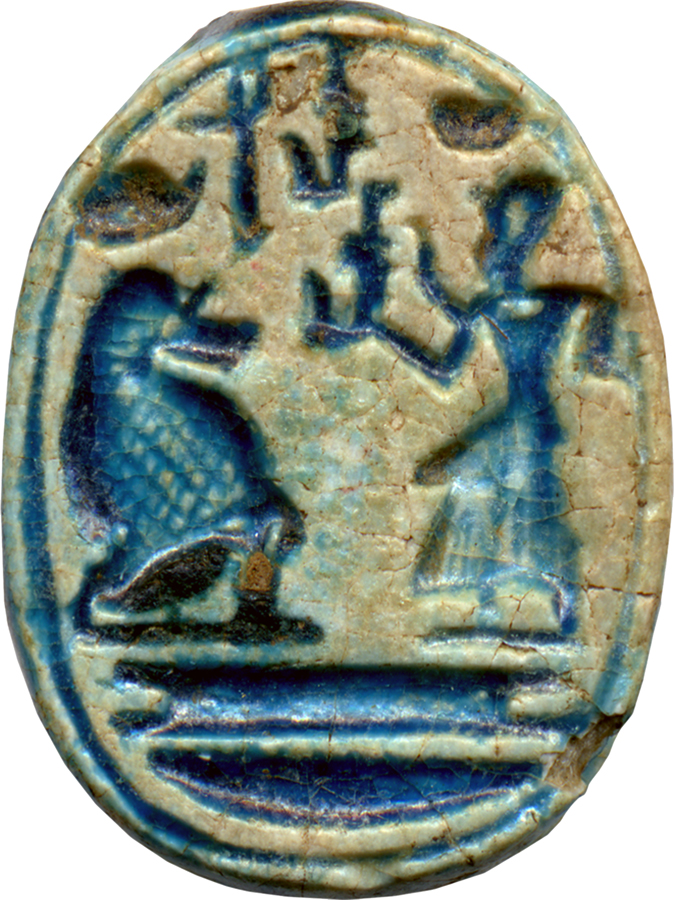
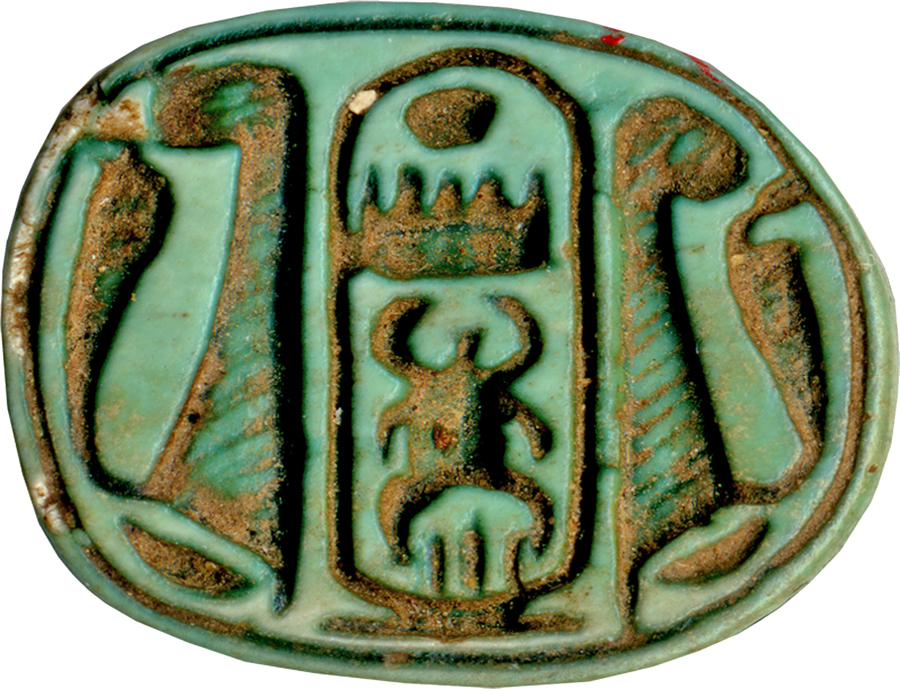
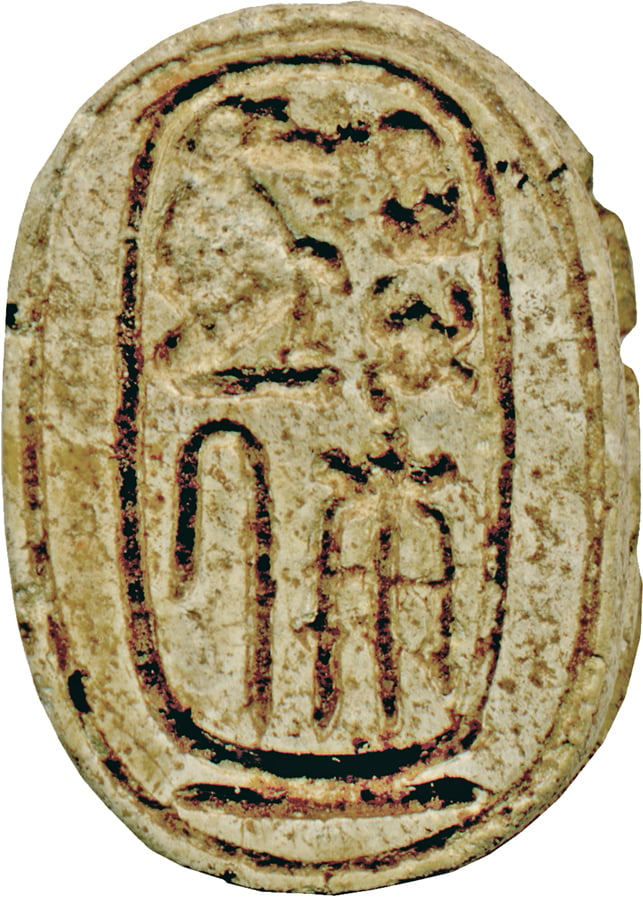
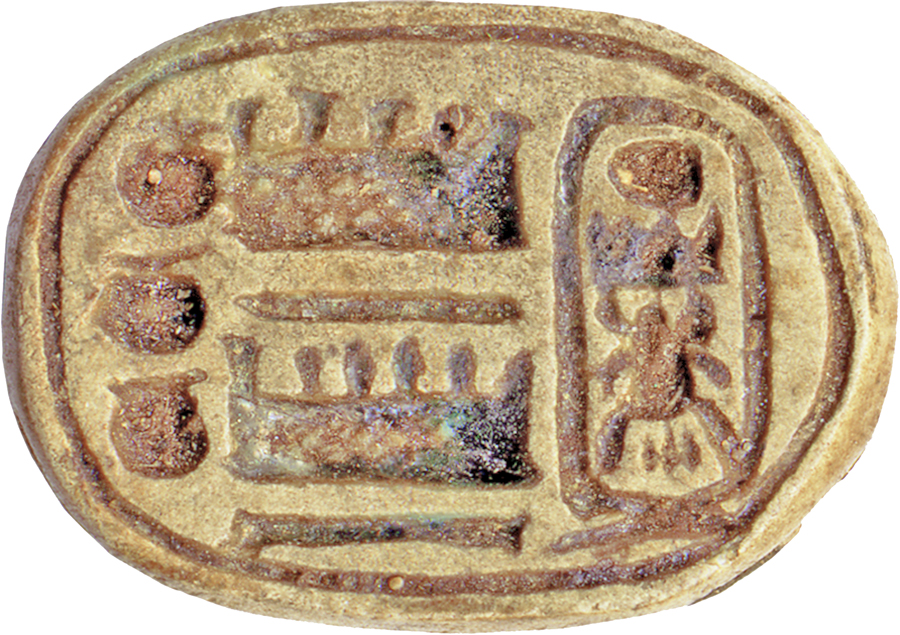
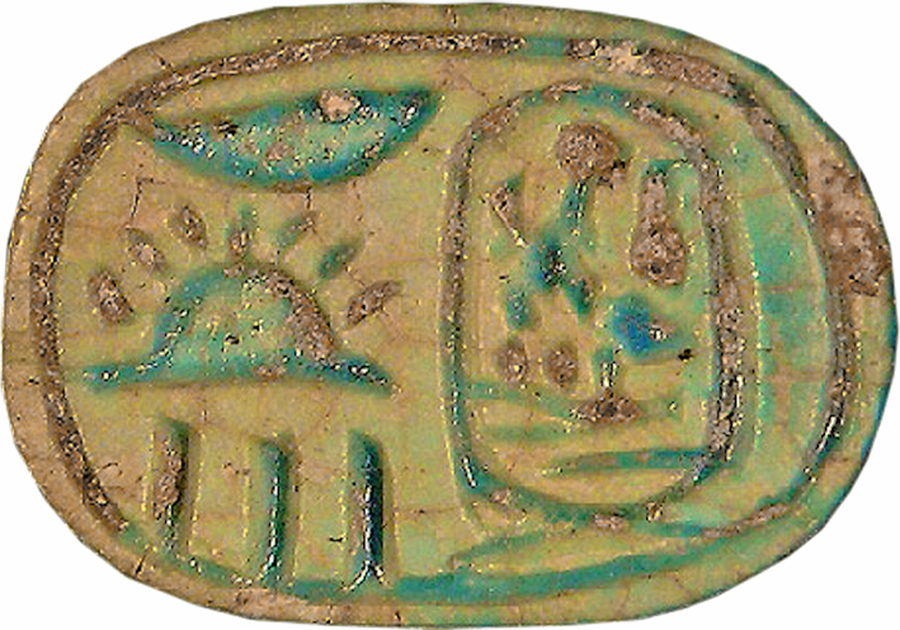
<p>The ancient Egyptians believed that the dung beetle, the Scarabaeus sacer, was one of the manifestations of the sun god. Representations of these beetles were used as amulets, and for ritual or administrative purposes. This scarab has a vertically arranged, left reading bottom inscription framed by an oval line. It contains the name of the female pharaoh Hatshepsut, and an epithet expressing her relation to the god Amun. The name of Amun is dominant by size and positioning in comparison to the royal name. The hieroglyphs are well carved, but slightly irregular, and the forms and arrangement typical for the early 18th Dynasty. The highest point of the scarabs back is the pronotum (dorsal plate of the protorax). Pronotum and elytron (wing cases) have single border and separation lines. V-shaped shoulder marks represent the humeral callosities (shoulder thickenings). The rectangular head has a semicircular insert, and is flanked by two-stage, quarter-spherical eyes. The trapezoidal side plates have curved outer edges and borderlines, and the clypeus (front plate) four frontal serrations, and two central base notches. The extremities have natural form, and show vertical hatch lines on the upper side of the fore- and midlegs for the tibial teeth, and pilosity (hair). The oval base is symmetrical. The scarab is longitudinally pierced, was originally mounted or threaded, and used as an amulet. It should secure the special relation between Hatshepsut and the god Amun, and provide a private owner with her royal patronage. There are many different variations of scarabs with the throne name of Hatshepsut and a variety of different epithets; the epithet "beloved of Amun" was not only for her a very popular one.</p><p>For the latest information about this object, <cite><a href='https://purl.thewalters.org/art/42.60' rel='external'>Scarab of Hatshepsut</a></cite>, visit the Online Collection of the Walters Art Museum.</p>
Machine-generated from the object's image on Jul 2026. Not curatorial; treat deities, names, and signs below as the model's best reading, not authority.
Oval scarab with a light greenish/cream field and scattered traces of green-blue glaze on an inset decorated surface, photographed from the front.
The object appears as an oval, domed scarab amulet with a raised border and a recessed/engraved central design. The central motif includes small painted/green-blue areas that resemble stylized figures and/or hieroglyphic-like signs, though the exact spell/signs are not fully legible at this resolution. Thin blue-green lines and pigment flecks are visible along the border and within the interior, suggesting partial glaze or pigment over a light-colored stone body. No clear cartouche or readable royal titulary is discernible. No external Greek/Coptic/Arabic text is visible.
Spotted an error, a mis-mapped findspot, or have a suggestion? We read every note.