WALTERS-EG
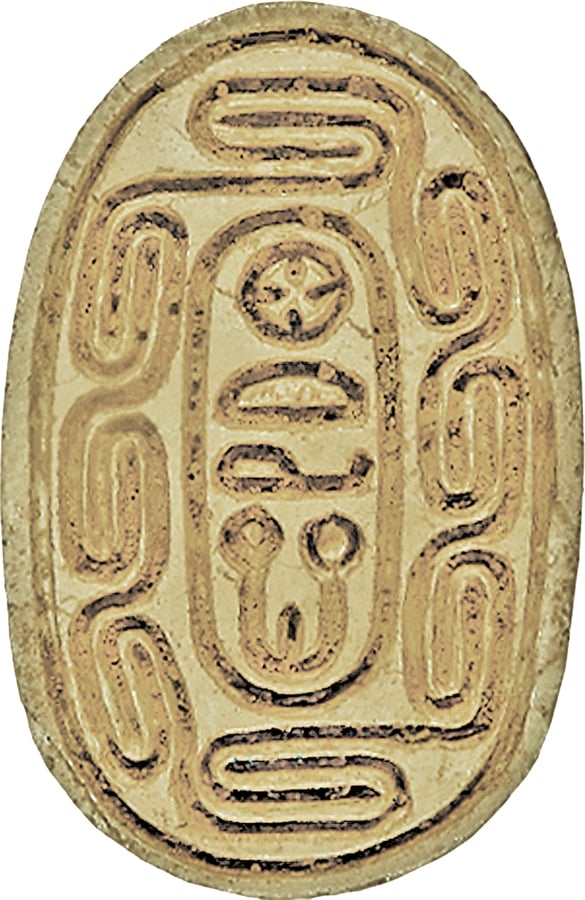
<p>The amulet should provide its owner with continual (oval frame) perfection and prosperity, as well as all-inclusive renewal (spiral scrolls).</p><p>For the latest information about this object, <cite><a href='https://purl.thewalters.org/art/42.25' rel='external'>Scarab Amulet</a></cite>, visit the Online Collection of the Walters Art Museum.</p>
Machine-generated from the object's image on Jul 2026. Not curatorial; treat deities, names, and signs below as the model's best reading, not authority.
A small oval scarab amulet of beige steatite with a raised, dark-incised field containing multiple vertical and curving hieroglyph-like forms, with a darker central motif.
The object is shown front-on as an oval disk typical of Egyptian scarab/amuletic designs. The surface is beige with clear darker outlines and infilled grooves, suggesting an originally glazed or pigment-filled design now worn. Around the recessed/incised border are thick, rounded strokes forming cartouche-like and text-like elements in vertical arrangement. At the center there is a raised element resembling a small column topped by a rounded/umbelliform form; beneath it sits a rounded terminal that could be decorative rather than securely legible text. No clearly identifiable royal cartouche (king’s name) or deity figure is unambiguous from the photo; the surrounding marks are consistent with hieroglyphic ornament typical of amulets but remain too indistinct to identify specific signs with confidence. No Greek/Coptic/Arabic text is visible. The catalogued materials (beige steatite, originally glazed) are consistent with the visible light stone and dark remaining in the incisions.
Spotted an error, a mis-mapped findspot, or have a suggestion? We read every note.