WALTERS-EG
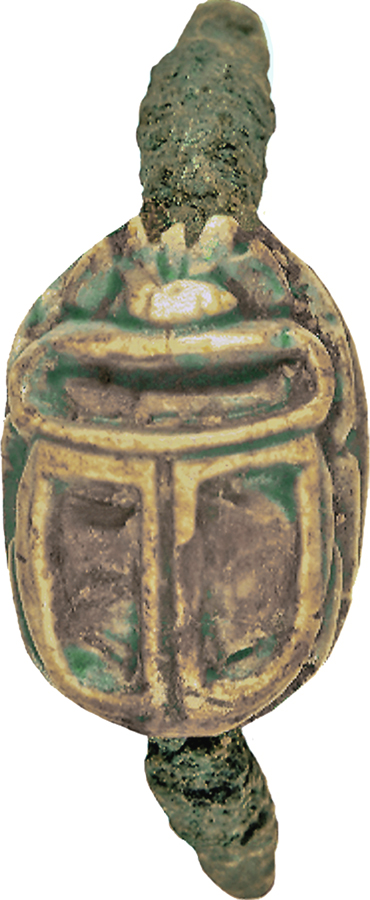
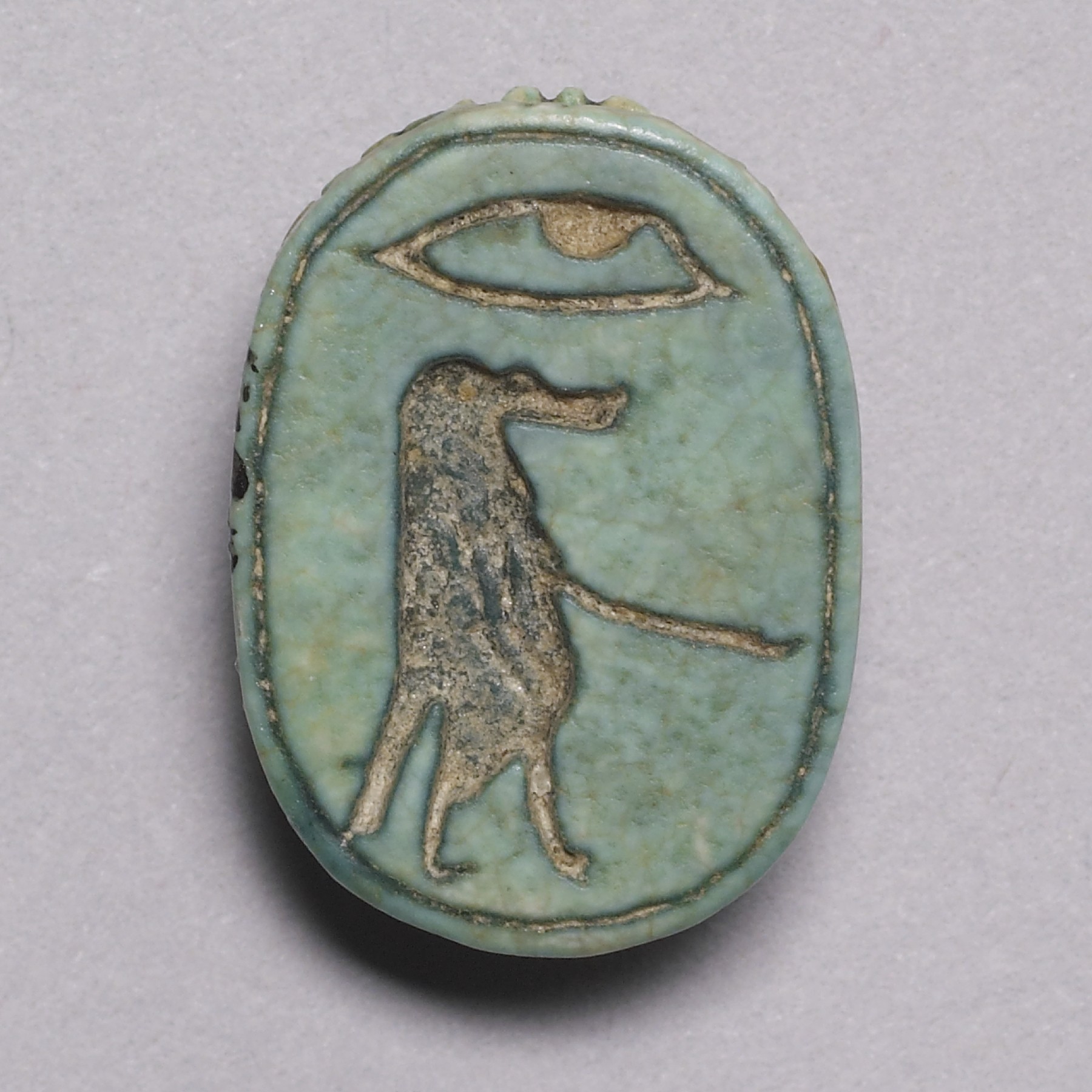
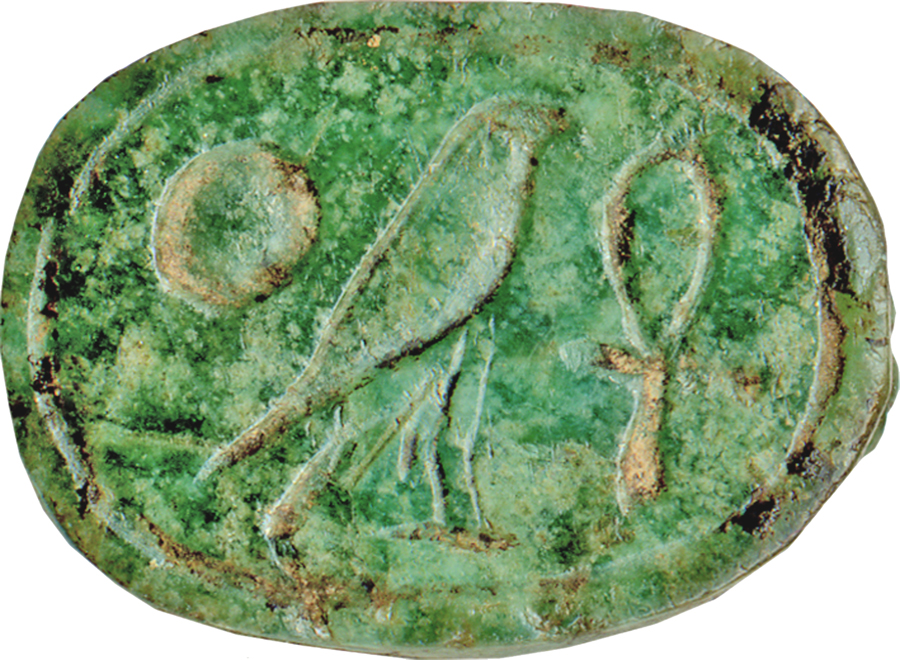
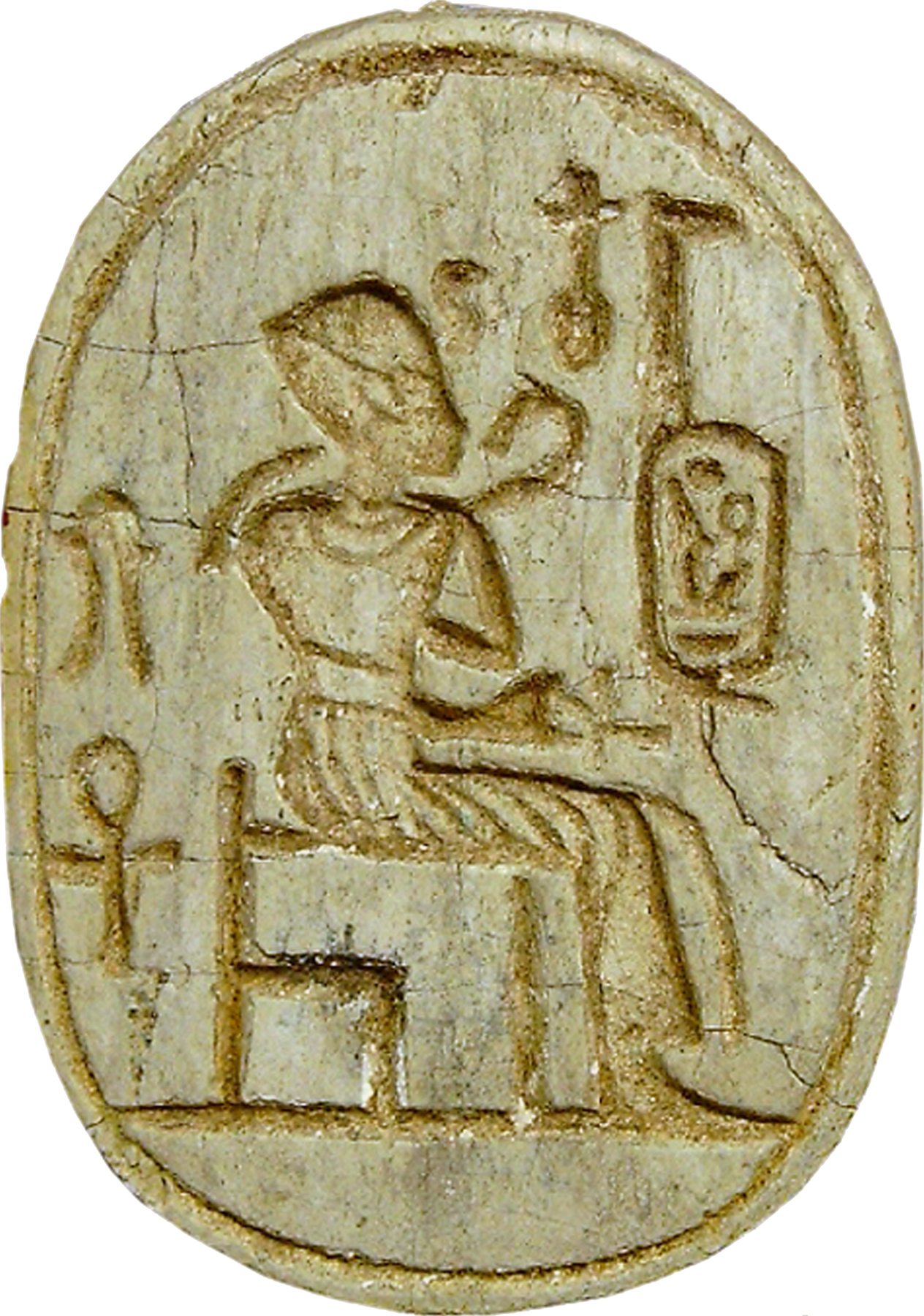
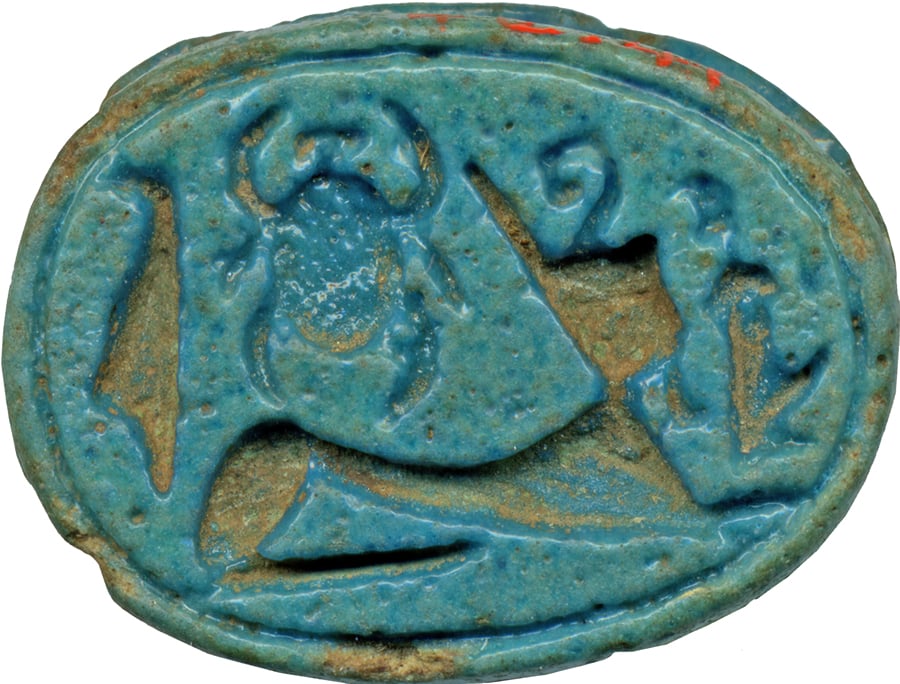
<p>The ancient Egyptians believed that the dung beetle, the Scarabaeus sacer, was one of the manifestations of the sun god. Representations of these beetles were used as amulets, and for ritual or administrative purposes. The bottom of this scarab displays a short, vertical inscription in an oval frame, which refers to the appearance of the sun god. It is enclosed by eight elongated, Z-shaped, interlocked spiral scroll elements. The numerical arrangement of the eight spiral scrolls is: 1+2x3+1 = 8. The bottom inscription and spiral décor is very precise and regularly incised, and the layout very well organized and symmetrically arranged. The highest point of the back is the partition between pronotum (dorsal plate of the prothorax) and elytron (wing cases), which is also defined by two short side-notches at shoulder height. As additional decoration run two deeply incised branches from the head to the middle of the elytron where they cross each other and end in one lotus blossom. The trapezoidal head is flanked by rectangular eyes; the side plates are irregular trapezoidal, and the clypeus (front plate) has five frontal serrations, and a central base notch. The raised, slender extremities have natural form and vertical hatch lines for the tibial teeth and pilosity (hair). The long-oval base is symmetrically. The scarab is longitudinally pierced, was originally mounted or threaded, and functioned as an amulet. It should secure the presence and renewal of the sun god, and for a private owner his divine support and renewal (eight spiral scrolls). The head and the back design with branches secure the dating in the 13th-15th dynasty.</p><p>For the latest information about this object, <cite><a href='https://purl.thewalters.org/art/42.14' rel='external'>Scarab Amulet</a></cite>, visit the Online Collection of the Walters Art Museum.</p>
Machine-generated from the object's image on Jul 2026. Not curatorial; treat deities, names, and signs below as the model's best reading, not authority.
Oval light beige steatite scarab amulet with carved hieroglyphic-like decoration surrounding a central small rosette-like motif.
The object is an oval/raised scarab-amulet form (back not visible) shown in close-up. The surface is light beige with darker carved lines defining recessed channels. Around the center is a symmetrical arrangement resembling hieroglyphic elements or protective inscriptions (stylized vertical and looped shapes), while the center contains a small circular/rosette-like motif. No explicit royal cartouche is clearly legible in the visible central field. The outer borders and internal grooves show wear and patchy darkening. No Greek, Coptic, or Arabic text is visible. No clear deity figure (human/animal) is identifiable beyond the scarab amulet motif itself.
Spotted an error, a mis-mapped findspot, or have a suggestion? We read every note.