WALTERS-EG
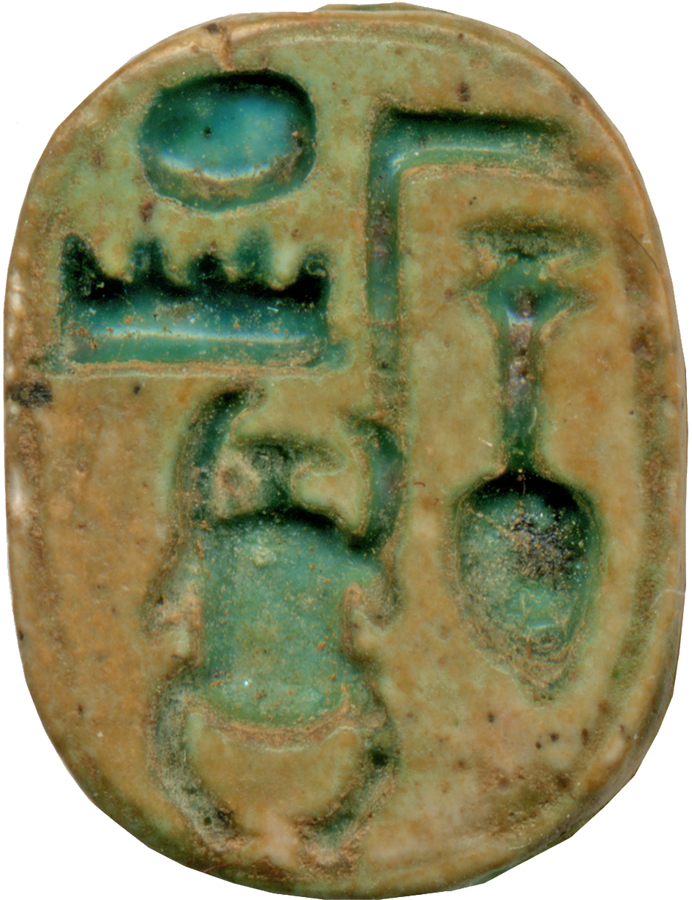
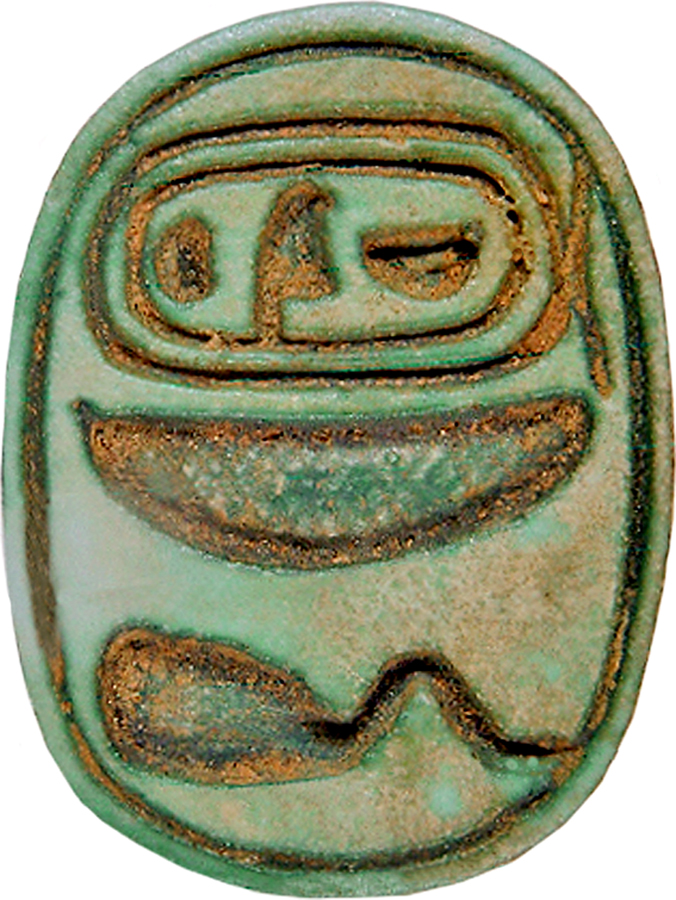
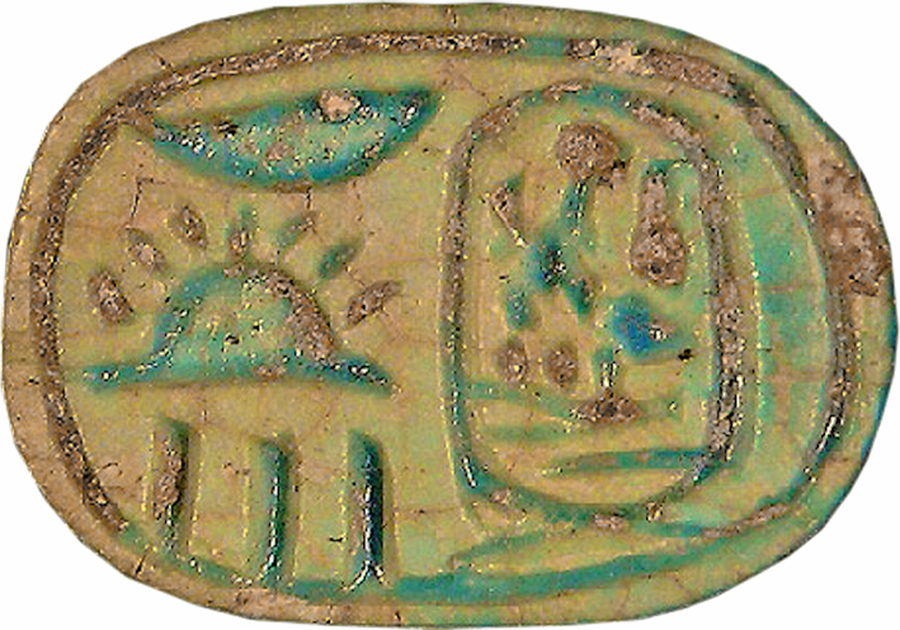
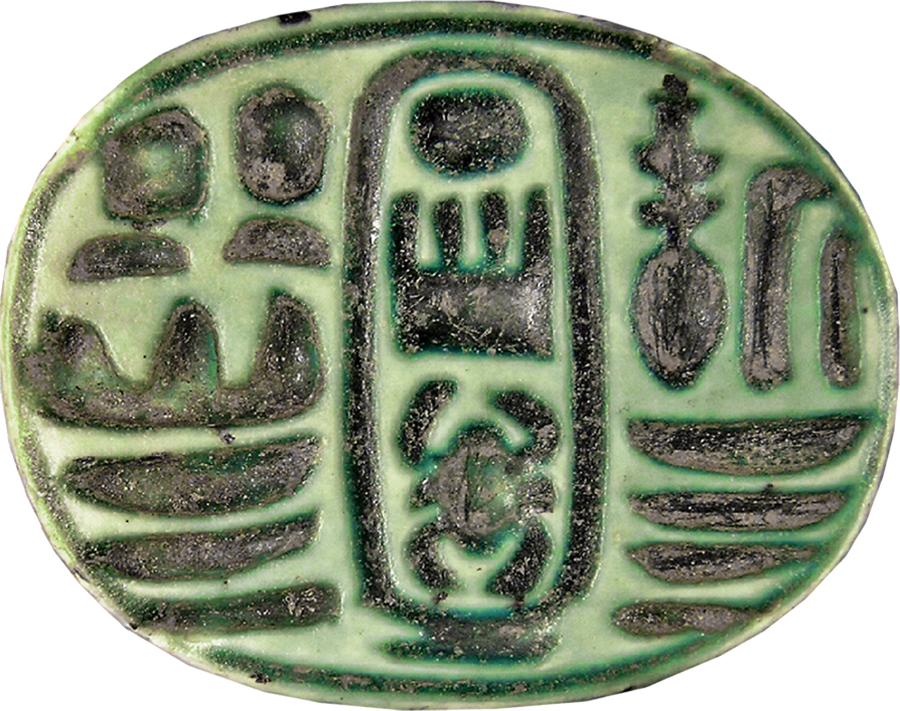
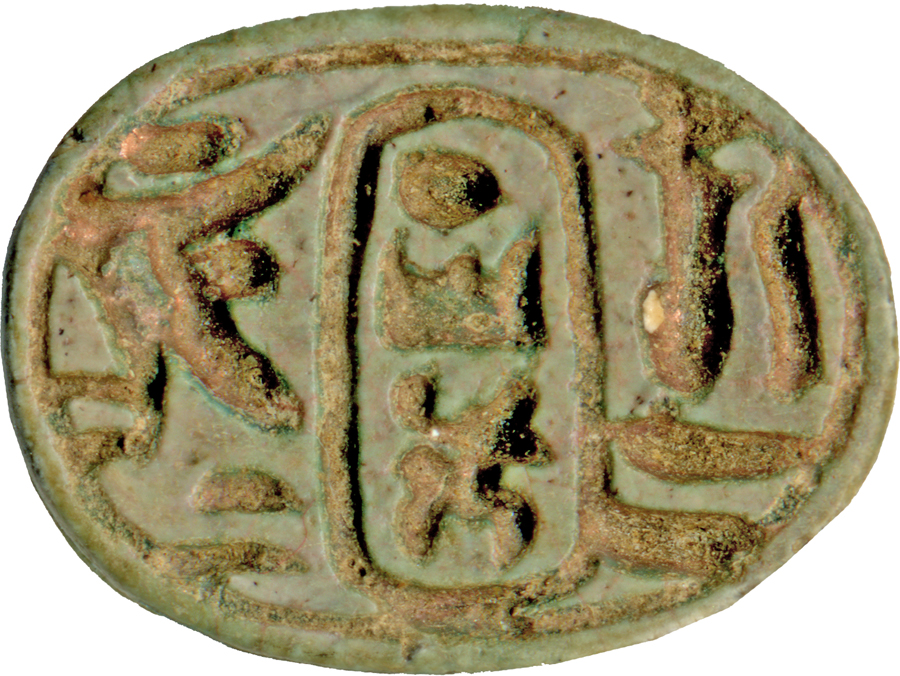
<p>The ancient Egyptians believed that the dung beetle, the Scarabaeus sacer, was one of the manifestations of the sun god. Representations of these beetles were used as amulets, and for ritual or administrative purposes.This scarab has a bottom design that displays King Amenhotep seated on his throne. He is dressed in a long pleated kilt, wears the so-called "Blue crown" with Uraeus-serpent and crown sash. The king holds with his left hand the crook in front of his chest, and with his right an ankh-sign (meaning "life"). The block throne has a small back. In front of him is a column with a left reading inscription, containing his throne name and title, and behind him the hieroglyphs for "protection" and "life." The layout is well organized, but it is notable that the royal figure does not fill the whole space, and that the Uraeus on the forehead of the king is unusually large. The highest point of the scarab's back is the pronotum (dorsal plate of the prothorax). Pronotum and elytron (wing cases) have deeply incised, fine borderlines, single separation lines, V-shaped marks for the humeral callosities (shoulder thickenings), and small side-depressions. The partition lines between pronotum and elytron meet V-shaped. The rectangular head is flanked by triangular eyes. The trapezoidal side plates have curved outer edges and borderlines, and the clypeus (front plate) has four frontal serrations and two central base notches. The raised, slender extremities have natural form; the background between the legs is deeply hollowed out. The low oval base is symmetrical.The scarab is longitudinally pierced, was originally mounted or threaded, and functioned as an amulet. It secures the existence ("life"), protection, divinity (title: "Perfect god"), and royal authority (cartouche, seated king with scepter) for the king, and provides a private owner with his patronage and protection.</p><p>For the latest information about this object, <cite><a href='https://purl.thewalters.org/art/42.376' rel='external'>Scarab</a></cite>, visit the Online Collection of the Walters Art Museum.</p>
Machine-generated from the object's image on Jul 2026. Not curatorial; treat deities, names, and signs below as the model's best reading, not authority.
An oval scarab-like seal amulet made of light-colored stone with brownish-gold painted or glazed decoration on one face.
The image shows a single oval scarab/spatially scarab-shaped object viewed front-on. The surface is light and appears encrusted or glazed, with a thin dark/brown outline around the rim. The decoration consists of a central winged/standing scarab figure with stylized legs and antennae, rendered in brownish lines, and a vertical emblem-like element to the right (possibly a cartouche/vertical hieroglyph group). Additional linear marks to the left and bottom resemble hieroglyphic signs. The lighting and wear suggest cracking and residue, but the exact signs are not fully legible at this resolution. No Greek/Coptic/Arabic text is visible.
Spotted an error, a mis-mapped findspot, or have a suggestion? We read every note.