WALTERS-EG
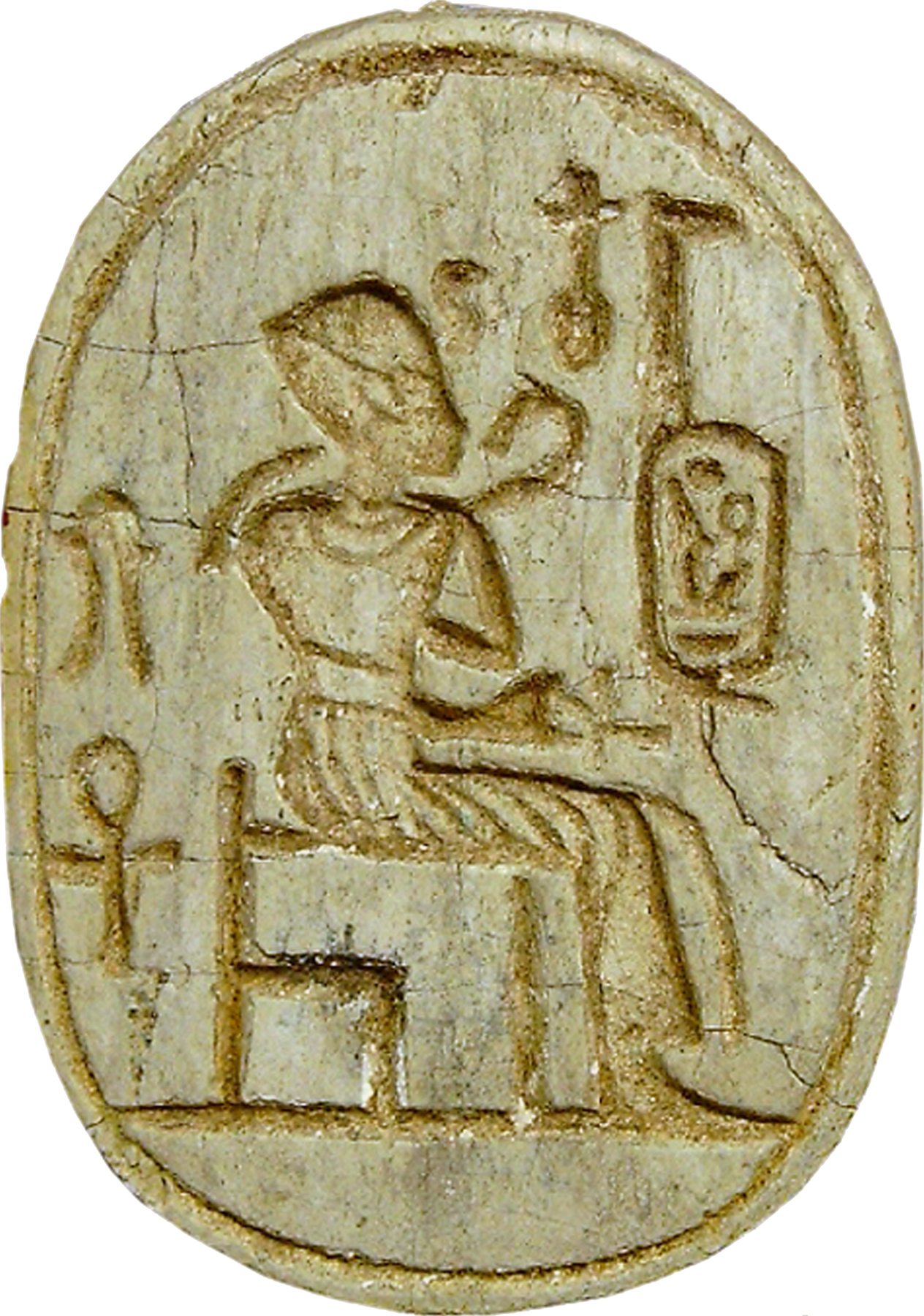
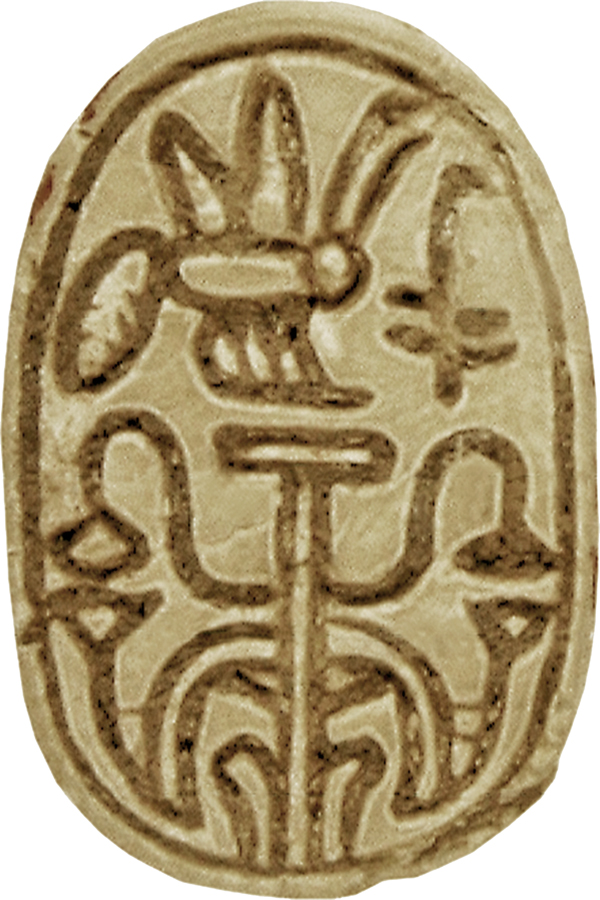
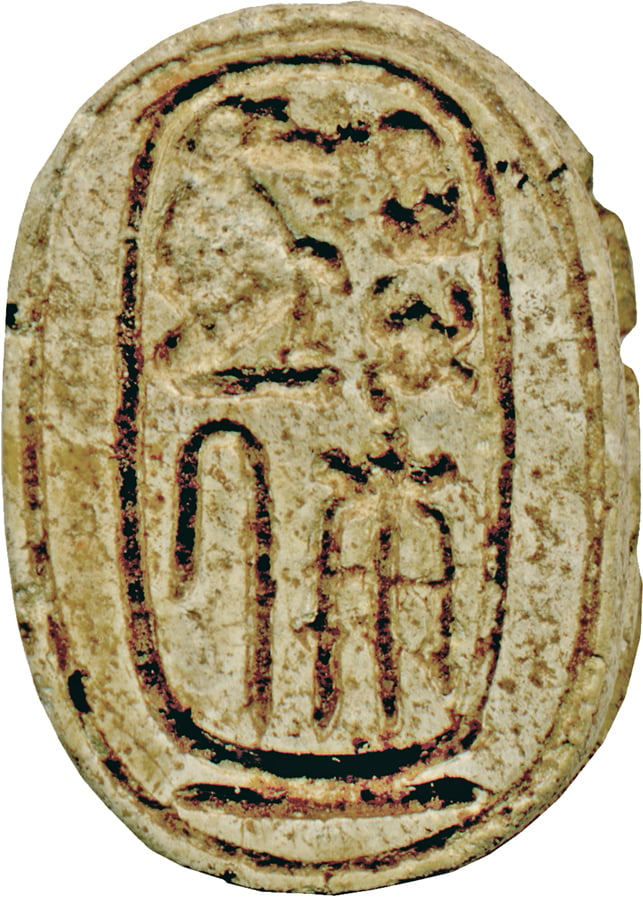
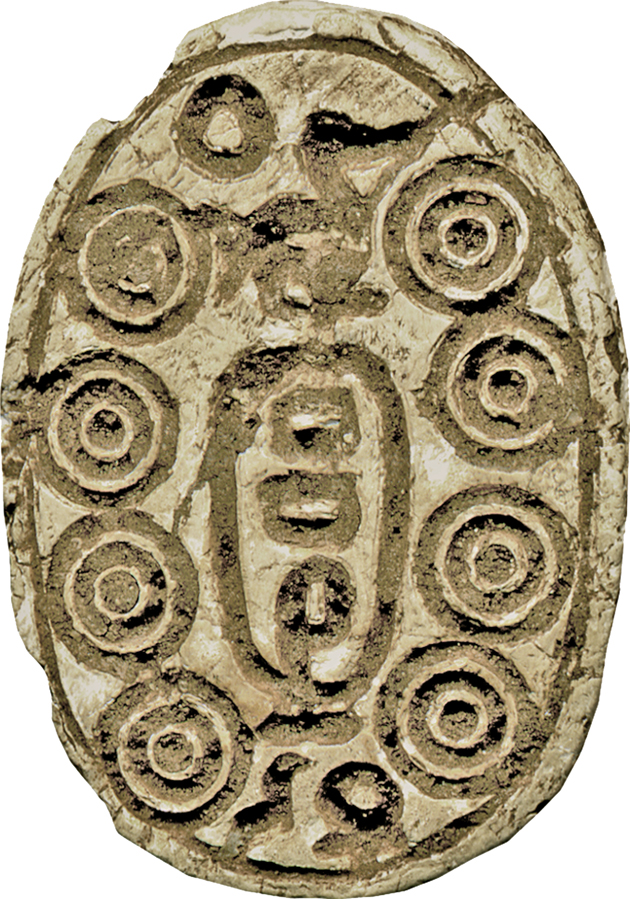
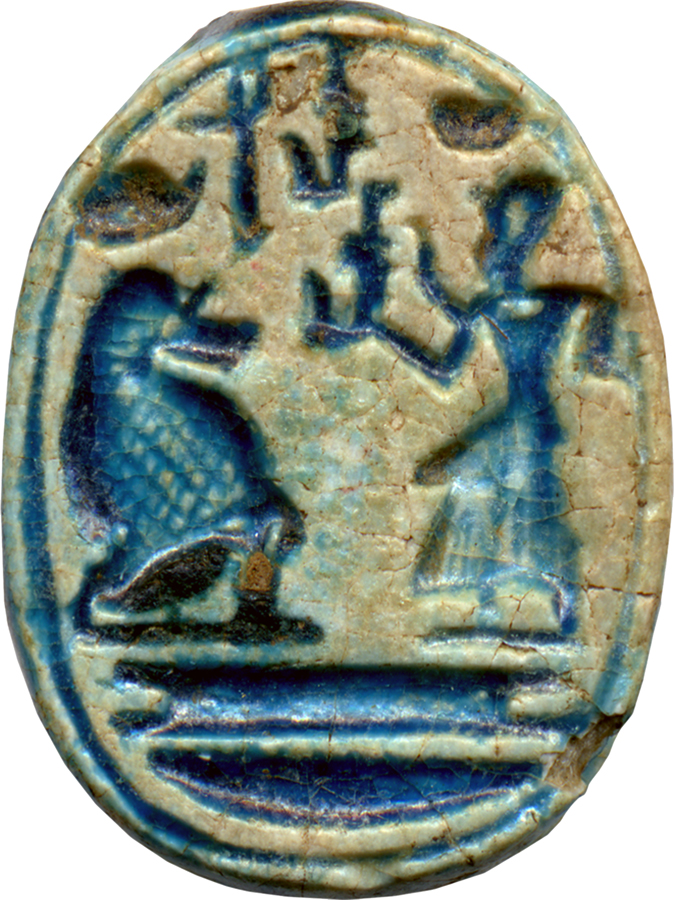
<p>The ancient Egyptians believed that the dung beetle, the Scarabaeus sacer, was one of the manifestations of the sun god. Representations of these beetles were used as amulets, and for ritual or administrative purposes. This ram headed scarab has bottom design that combines divine images with the name of the Kushite King Shabaqo. The ensemble is organized on three levels: First a solar barque with rudder; second a winged sun-disk, a raised cobra and a royal cartouche-separated by a vertical space divider from each other-; and third a nb-basket in the lower round. The image divider protects the royal name from the power of the serpent, which faces the cartouche. An oval double line with rope pattern frames the arrangement. The shape of the incised images and hieroglyphs is precise and the inner structures very detailed, the oval frame and the wings of the sun-disk with diagonal, evenly and narrowly spaced hatch lines, the shield of the cobra with a cross-line pattern and the nb-basket with a tightly packed, diagonal hatch line pattern; the layout is very well organized. The back shows a beetle body, a ram head crowned with a sun disc and Uraeus-serpent. A collar of four rows with square pattern covers the pronotum (dorsal plate of the prothorax). The elytron (wing cases) has incised borderlines, which ends at the rear in spiral elements with lotus buds; quadruple line divides the wing cases. The design of the back is not standardized, the collar executed in raised relief, and the head sculpted in the round; the incised lines and notches are thick and slightly irregular. The combination of beetle body and ram head is excellently meshed by a greater space having been given to the ram head and collar in comparison to the elytron. The carved, slender extremities have natural form, and deeply incised vertical hatch notches. The long-oval base is symmetrical. The scarab is longitudinally pierced, was originally mounted or threaded, and functioned as an amulet. This amulet has a multilevel connotation related to the god Amun-Re (scarab with ram head, Amun trigram, divine barque as cryptogram for Amun) combined with a focus on the king Shabaqo, who was believed to be chosen as Amun's earthly representative. The amulet should secure the royal authority (cartouche) of this king, as well as the divine support (ram head, solar barque) and protection (winged sun-disk, cobra) for the king; it also could provide an elite owner with royal patronage and divine protection. The throne name Nfr-k3-Rc was also used by king Ramesses IX of the late 20th Dynasty, but the iconography, layout, and style of the scarab make it more likely that the scarab was carved for king Shabaqo. Ram headed scarabs were common since the New Kingdom, but became especially popular in the Kushite Period, the 25th Dynasty.</p><p>For the latest information about this object, <cite><a href='https://purl.thewalters.org/art/42.44' rel='external'>Scarab with a Ram's Head</a></cite>, visit the Online Collection of the Walters Art Museum.</p>
Machine-generated from the object's image on Jul 2026. Not curatorial; treat deities, names, and signs below as the model's best reading, not authority.
Oval scarab-shaped amulet with a ram’s-head motif at the center, surrounded by an incised border of leaf-like or feather-like arcs.
The object is shown front-on as an oval, scarab/amulett-like plaque. The central register contains a ram’s head rendered in relief (small circular face with horn-like elements) above a broad horizontal bar. Below, two symmetrical vertical elements flank a rectangular inner frame on the right that encloses a standing figure-like form. The surface is heavily worn and stained, with darker incised lines contrasting against a light beige-brown body. An outer border consists of repeated curved, leaf/feather-like strokes. No clear cartouche or royal name is visible. No legible Egyptian hieroglyphs, Greek, Coptic, or Arabic text are identifiable in the image; markings appear purely decorative/figural rather than text. The original catalogue material notes steatite with traces of blue/green glaze; in this image, no distinct surviving blue/green glaze is clearly resolved, though light reflective spots and worn white/bright patches may represent remaining surface glaze or mineral wear.
Spotted an error, a mis-mapped findspot, or have a suggestion? We read every note.