WALTERS-EG
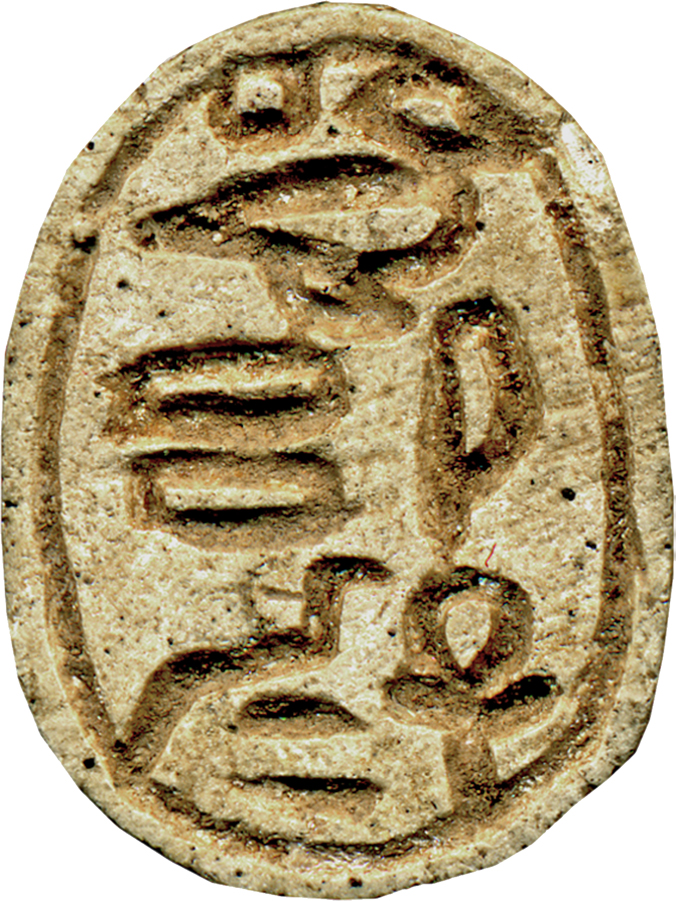
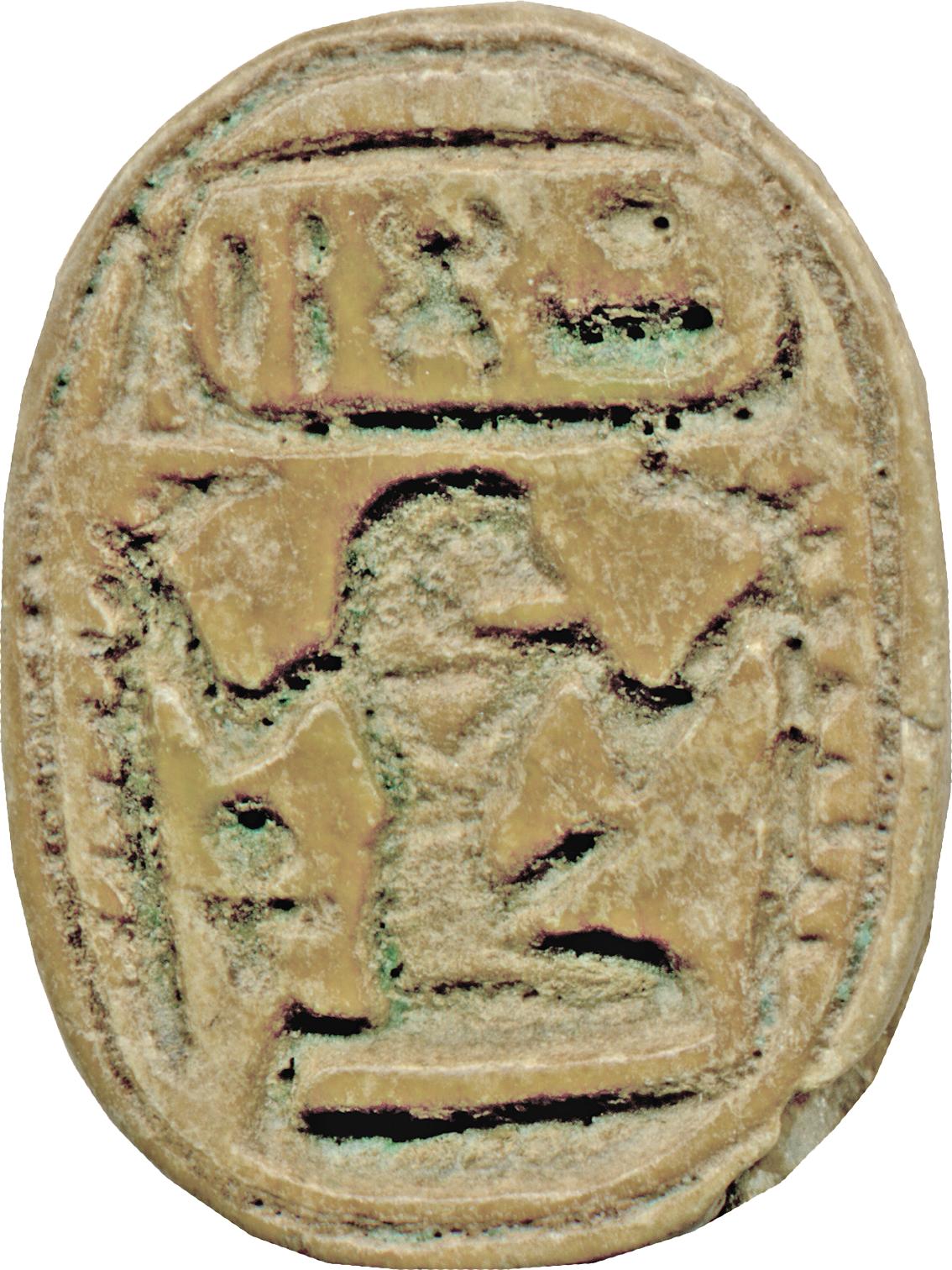
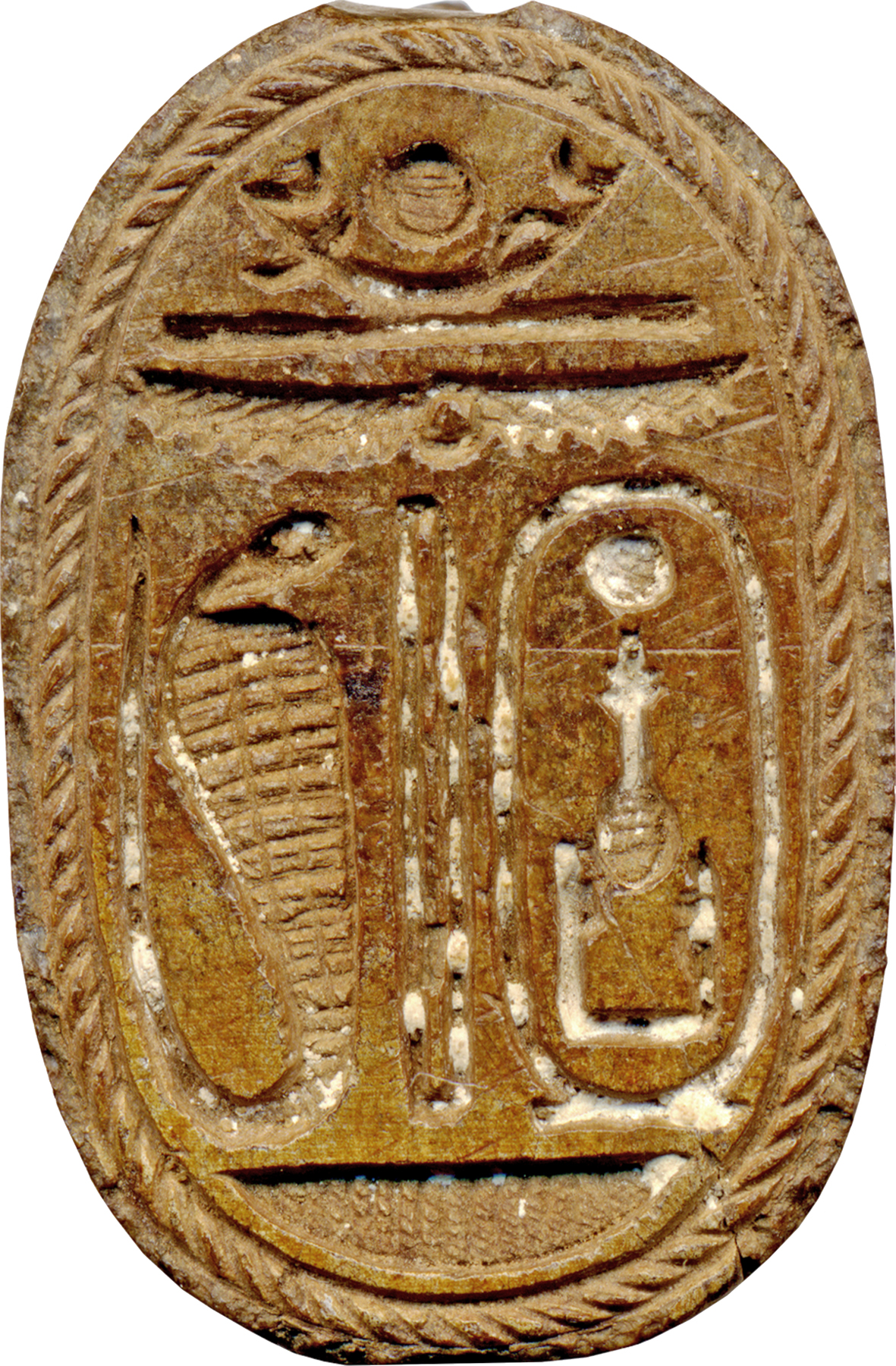
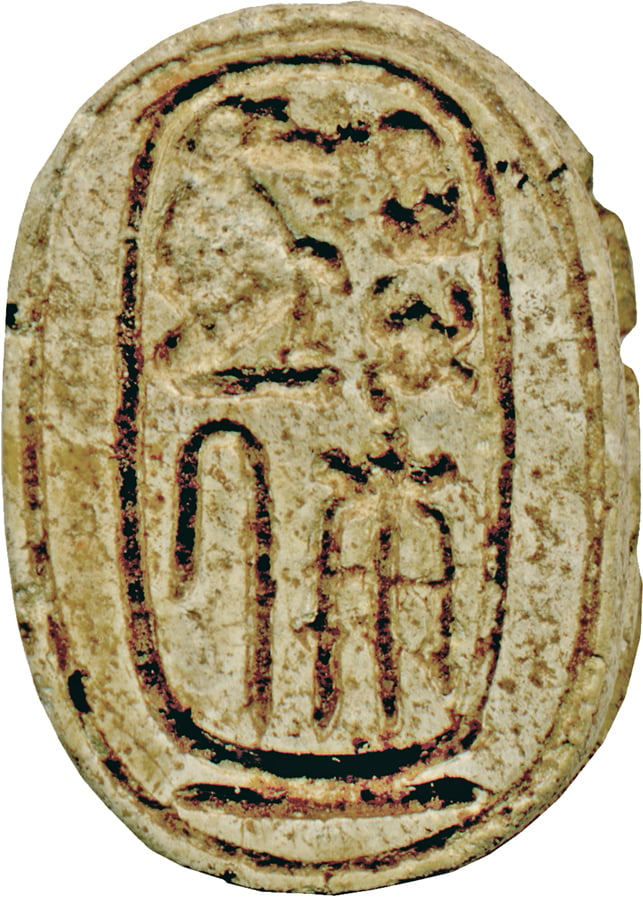
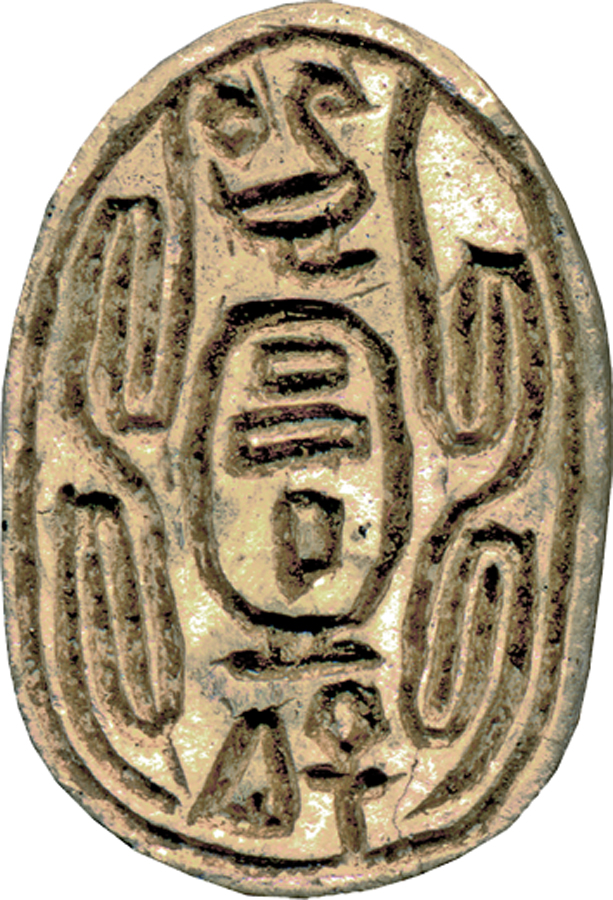
<p>The ancient Egyptians believed that the dung beetle, the Scarabaeus sacer, was one of the manifestations of the sun god. Representations of these beetles were used as amulets, and for ritual or administrative purposes. This scarab has a bottom inscription, which contains the name and title of the King Sheshi, as well as a formula wishing him life. The inscription is deeply carved with thick lines, and the shape of the hieroglyphs is somewhat clumsy. The layout is irregularly organized, and the top and bottom signs collide with the borderline. The incised circle-design that frames the inscription, is exact and symmetrically arranged, which contrasts with the more sloppy forms and arrangement of the hieroglyphs; additionally, the last two signs in the lower round are very compressed, and collide with the borderline. It is possible to explain the discrepancy between the exactly executed circle pattern and the inscription either with two different hands - of a scribe and of a pattern cutter - or, and more likely for such a small object, with the use of a kind of compass or stencil for the execution of the pattern. The highest point of the scarab's back is at the partition between pronotum (dorsal plate of the protorax) and elytron (wing cases). The small, semicircular head is framed by borderlines, and the side plates are trapezoidal. The clypeus (front plate) has four frontal serrations, and a central base notch. Two side-notches at shoulder height, which are short and not aligned, define the partition between pronotum and elytron. The raised, slender extremities are naturally formed, and show deeply incised, slightly irregular hatch lines for tibial teeth and pilosity (hair). The background between the legs is hollowed out, and the central triangle shifted slightly to the front. The base is symmetrically oval, and the drill-holes are framed. The scarab is longitudinally pierced, was originally mounted or threaded, and used as an amulet. Such an amulet should on one side secure the existence and divine monarchy for this king, and on the other provide its private owner with his royal patronage. The identification of Sheshi with one of the Hyksos rulers or their vassals is likely, but not secure.. The meaning of the circles' arrangement is difficult to determine; nevertheless, given its similarity to the hieroglyphic sign of the sun disk, it may assure renewal.</p><p>For the latest information about this object, <cite><a href='https://purl.thewalters.org/art/42.26' rel='external'>Scarab with the Cartouche of Sheshi</a></cite>, visit the Online Collection of the Walters Art Museum.</p>
Machine-generated from the object's image on Jul 2026. Not curatorial; treat deities, names, and signs below as the model's best reading, not authority.
Photograph of a small Egyptian scarab-shaped amulet engraved with a central vertical motif framed by circular/bull’s-eye shapes and surrounded by border markings.
The object is a steatite scarab/amulet viewed front-on. A rounded oval body is bordered by an outer ring. Inside, a central vertical register contains a boxed figure resembling hieroglyphic signs, while multiple circular elements (ringed disks and dot-like centers) are arranged around it, forming a decorative field. The engraving is filled with dark pigment/ink contrast in the recesses. No clear seated scarab legs or elytra details are discernible in this view; the focus appears to be the inscribed cartouche-like central element and surrounding decorative signs. The catalogue’s identification as a scarab with the cartouche of Sheshi is plausible in form, but the specific “Sheshi” cartouche cannot be read unambiguously from this image, so the royal name confirmation is limited.
Spotted an error, a mis-mapped findspot, or have a suggestion? We read every note.