WALTERS-EG
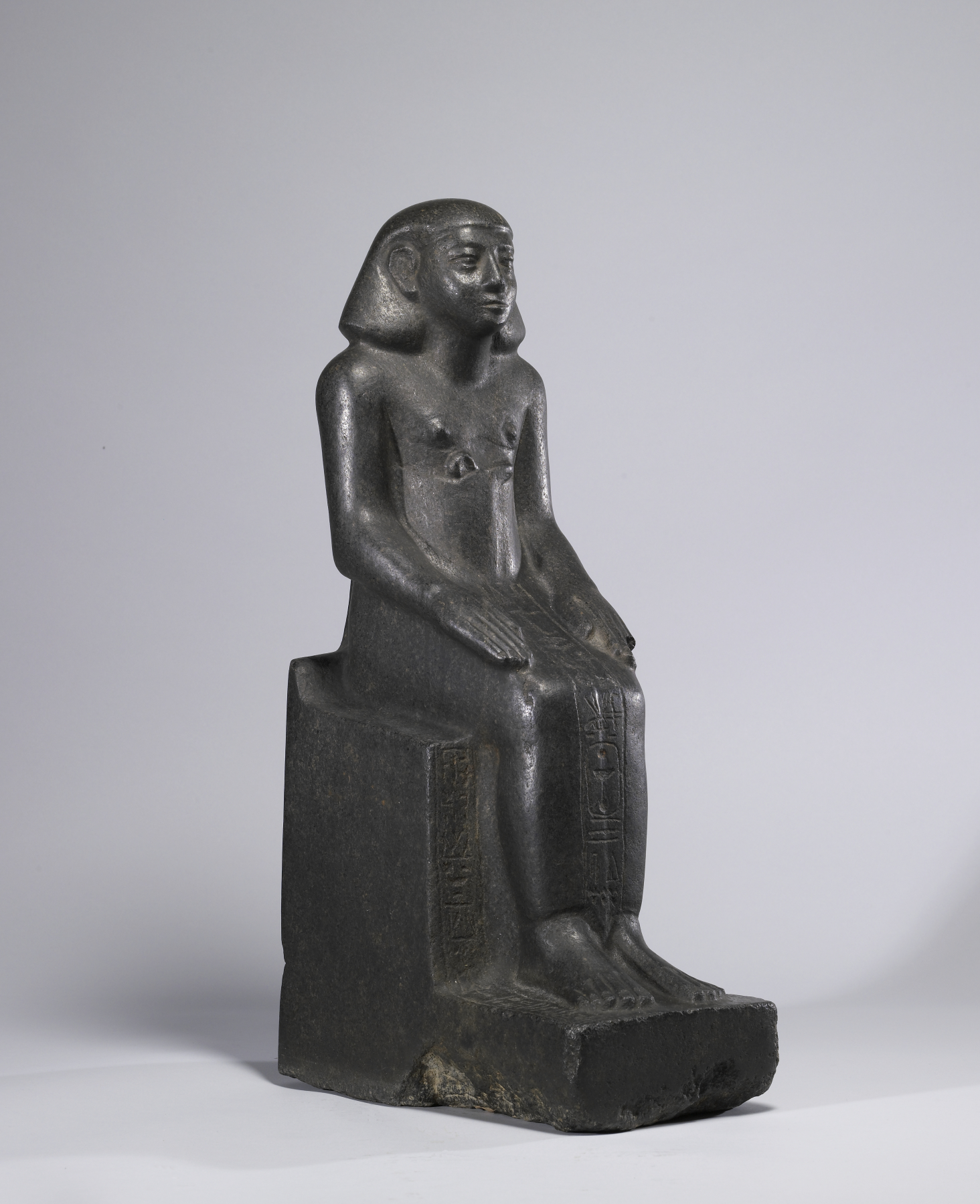
<p>Depicted much as she would have appeared in life, the Chantress Nehy sits on a chair and holds in her left hand the symbol of her profession, a sistrum or rattle used in the worship of the goddess Hathor. Judging from her fine clothing and elegant hairstyle, as well as the scale and quality of her statue, we may assume that Nehy was able to afford a fine burial to ensure her place in the afterlife. Most likely this statue, one of two known, graced a tomb at Saqqara, the ancient necropolis of Memphis.</p><p>For the latest information about this object, <cite><a href='https://purl.thewalters.org/art/22.106' rel='external'>Seated Statue of Nehy</a></cite>, visit the Online Collection of the Walters Art Museum.</p>
Machine-generated from the object's image on Jul 2026. Not curatorial; treat deities, names, and signs below as the model's best reading, not authority.
A seated male figure carved in limestone, hands clasped and seated on a rectangular base, with vertical incised lines of hieroglyphs on the side of the legs and base.
The image shows a freestanding seated statue of a man in Egyptian style: he sits upright on a rectangular plinth with legs extended forward, wearing a long garment covering the lower body and a wig or headdress that frames the face. The arms are bent, and the hands are brought together in front of the chest/upper torso area. The surface is carved from light-colored stone and bears incised detailing on the clothing and body. Along the proper right side/edge of the legs and plinth there are vertical lines of hieroglyph-like incisions, but the individual signs are not clearly legible at this resolution. No clear cartouches or royal titulary are visible. No modern text (Greek/Coptic/Arabic) is apparent in the photograph.
Spotted an error, a mis-mapped findspot, or have a suggestion? We read every note.