ARTIC-EG
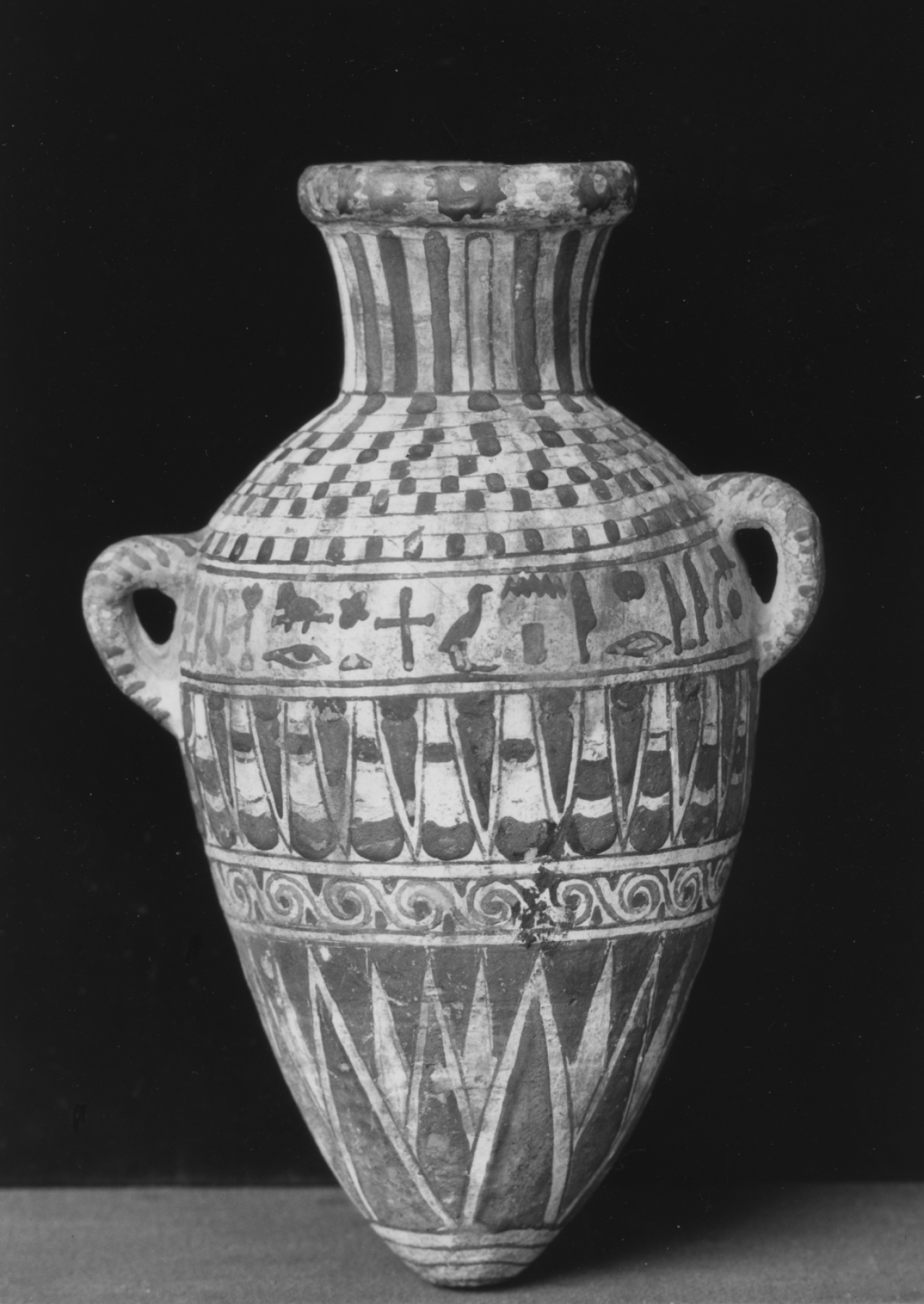
One of a set of four jars that belonged to Amenhotep, who oversaw architectural projects in the temple of Amun at Karnak (in present-day Luxor). Now empty, the jars once held Amenhotep’s liver, lungs, intestines, and stomach, which were removed during the mummification process. Each jar has a hand-sculpted stopper that may represent its owner or one of the four sons of Horus, a set of gods associated with these vital organs. An inscription in hieroglyphs on each container promises divine protection over its contents by a different goddess: Selket, Neith, Nephthys, or Isis.
Machine-generated from the object's image on Jul 2026. Not curatorial; treat deities, names, and signs below as the model's best reading, not authority.
A painted ceramic canopic jar with a human-headed lid (mummiform face) and registers of incised/painted hieroglyphic text on the body.
The object appears as a tall, conical ceramic jar with a rounded shoulder and an inserted lid topped by a stylized human face. The lid/upper portion is painted with a dark headpiece or hair framing the face; the face has outlined eyes and a straight mouth, with skin tones rendered in ochre/yellow and darker contours. The main jar body is a pale buff ceramic surface with multiple rectangular blocks and lines of hieroglyphic signs painted in brown/black pigment, arranged in columns and registers. No clear cartouche or royal titulary is legible at this resolution, and individual signs are not confidently identifiable. Overall appearance is consistent with decorated funerary storage for organs (canopic jar type), though the specific attribution to “Amenhotep” cannot be confirmed from visible text in this image. No Greek, Coptic, or Arabic text is visible.
Spotted an error, a mis-mapped findspot, or have a suggestion? We read every note.