ARTIC-EG
One of a set of four jars that belonged to Amenhotep, who oversaw architectural projects in the temple of Amun at Karnak (in present-day Luxor). Now empty, the jars once held Amenhotep’s liver, lungs, intestines, and stomach, which were removed during the mummification process. Each jar has a hand-sculpted stopper that may represent its owner or one of the four sons of Horus, a set of gods associated with these vital organs. An inscription in hieroglyphs on each container promises divine protection over its contents by a different goddess: Selket, Neith, Nephthys, or Isis.
Machine-generated from the object's image on Jul 2026. Not curatorial; treat deities, names, and signs below as the model's best reading, not authority.
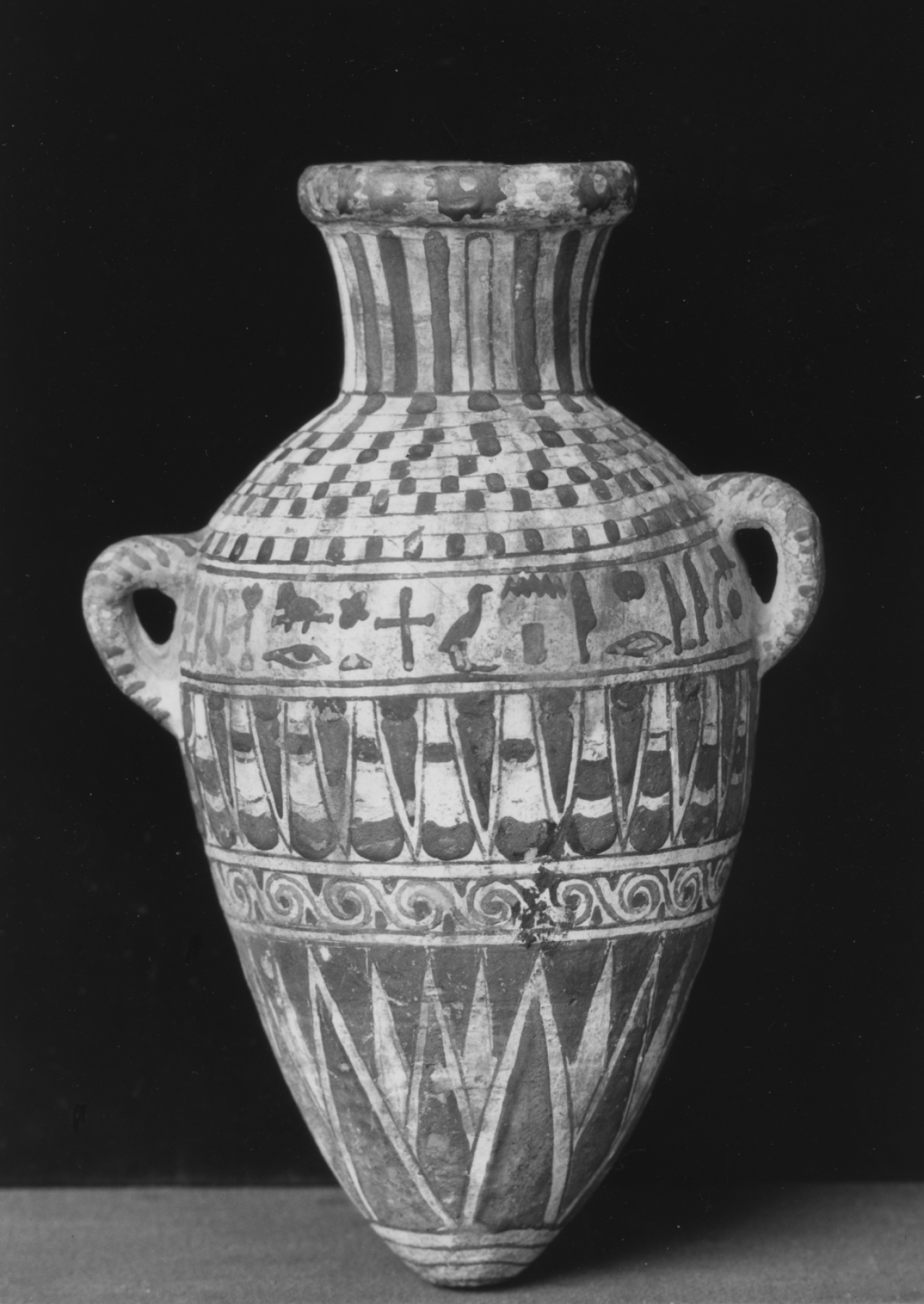
A painted canopic jar with a human (mummiform) head lid and a register of dark-painted hieroglyphs on the jar body.
The object appears as a ceramic canopic jar: a rounded, beige jar body is topped with a painted head-shaped lid showing a stylized human face (dark hairline, eyebrows, and eye details) and a pale complexion. Across the front of the jar body is a large vertical section of dark pigment hieroglyphs arranged in multiple boxes/registers. The hieroglyphs include rectangular sign frames and other conventional Egyptian sign forms, though the exact names and formulae are not clear enough to read reliably at this resolution. No clear Greek, Coptic, or Arabic text is visible. No explicit royal cartouche is clearly legible in the image. Condition is somewhat worn: the pigment shows fading and scuffing, but the jar form and painted head are intact.
Spotted an error, a mis-mapped findspot, or have a suggestion? We read every note.