Description
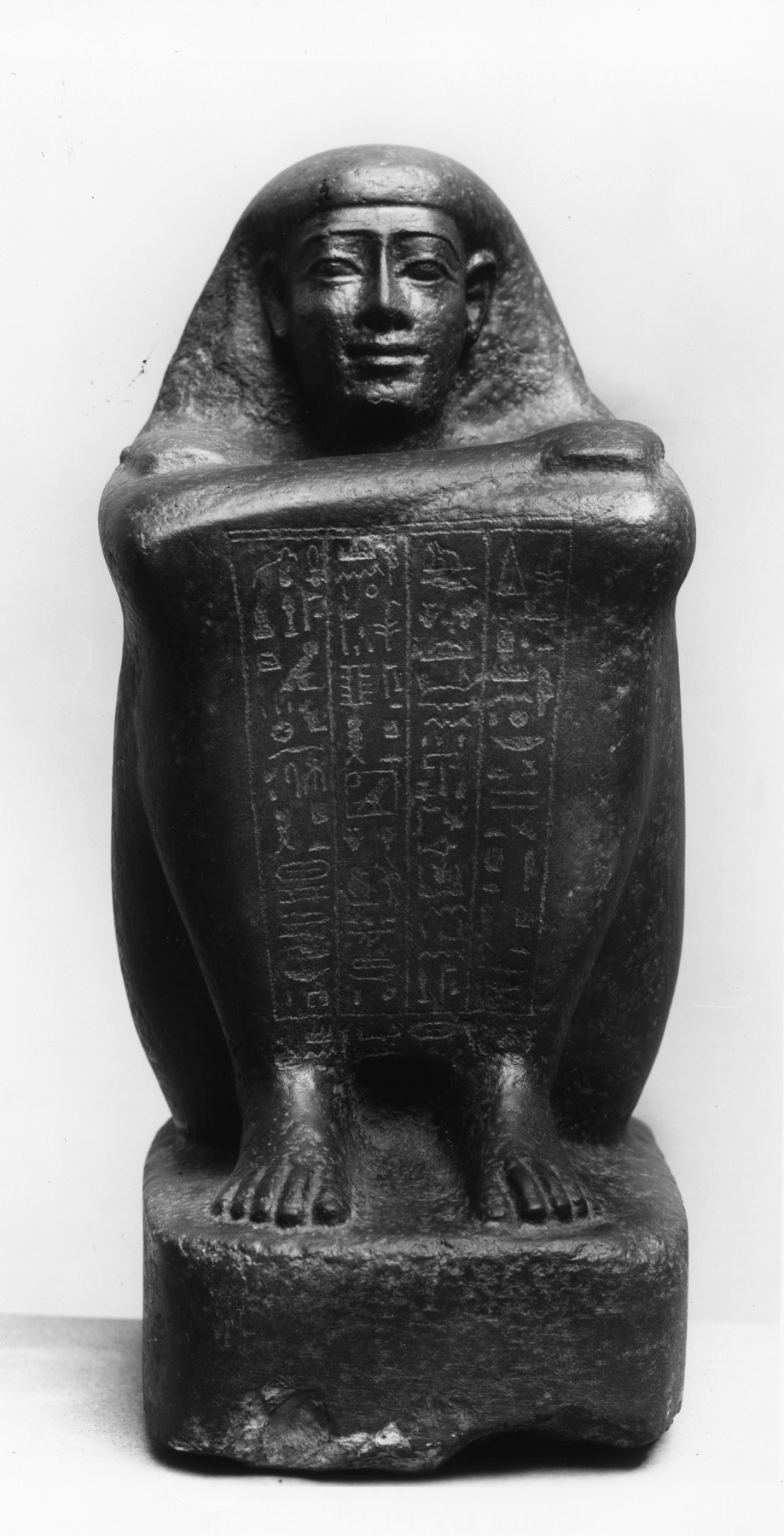
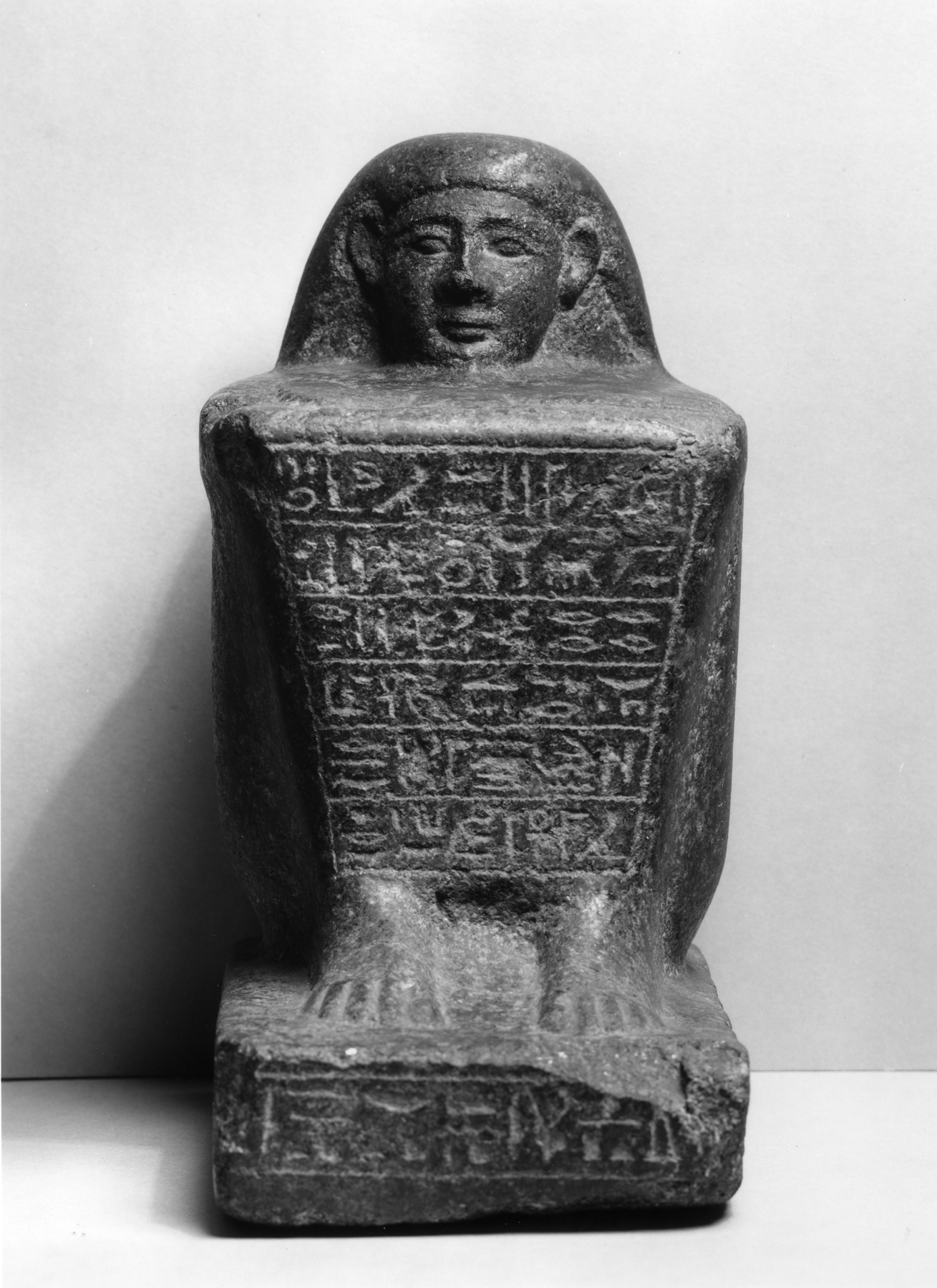
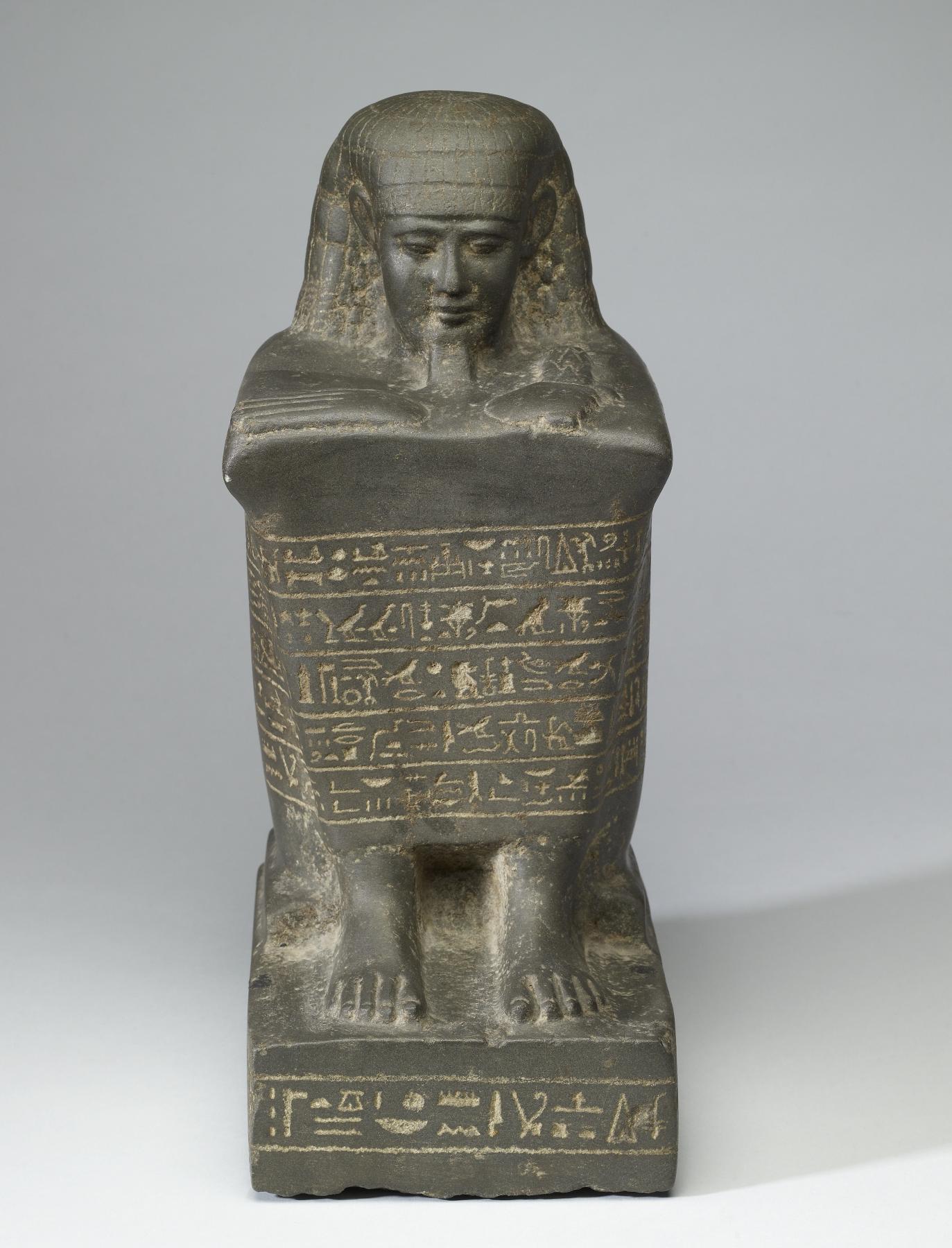
<p>This block statue depicts a squatting figure with his knees drawn up and arms crossed on his knees. He wears a large wig and has a beard. Inscriptions run on the front dress, right and left sides of the dress, and in columns in the rear.</p><p>For the latest information about this object, <cite><a href='https://purl.thewalters.org/art/22.183' rel='external'>Block Statue of Nes-Min</a></cite>, visit the Online Collection of the Walters Art Museum.</p>
AI image analysis GPT-5.4-nano
Machine-generated from the object's image on Jul 2026. Not curatorial; treat deities, names, and signs below as the model's best reading, not authority.
A seated/standing block statue (or block-form figure) of an Egyptian individual carved in dark stone, with a smoothed head and a wide, rectangular inscription panel on the torso.
The artifact depicts a human figure in a block-statuary pose: a rounded, simplified head with a short, straight wig is visible, and the torso forms a thick rectangular block. The lower portion appears truncated/short, consistent with a block statue format. A large rectangular field on the front of the body is densely carved with hieroglyphs arranged in multiple horizontal lines and bordered by frame lines. The surface shows wear and slight chipping, with the inscriptions still legible in places but not fully clear in detail from this image. No Greek/Coptic/Arabic text is visible. The overall stone color appears dark gray to black with lighter weathering/granular texture, consistent with dark granite as catalogued.
royal
Ancient Egyptian (period unclear; inscription and style suggest Old/Middle Kingdom or later block statue tradition, exact dating unclear)
fragmentary
Materials
dark stoneblack/dark granite (as catalogued)
Signs
multiple hieroglyphs (bird/house/rectangular frame elements and other unidentified forms) ×50
Inscriptions (2)
Inscription #1
English description
[On front and sides above main inscription] ""Amun"", ""Mut"", and ""Khonsu"", ""the divine father, Nes-Min, the blessed.""
Inscription #2
English description
[Main inscription] An offering which the king gives to Amon-re, lord of the thrones of the Two Lands, who is in command in Epet-sewet, the primeval god of the Two Lands, glorious by his arm, bull of his mother, the king of the gods, who is gleaming beautifully in Thebes, the full moon, the prince of the stars; offering brought on his altar, cool water sprinkled (?) upon his offering-table, all good and pure things, all gifts, vegetables, which come forth upon his altar daily, after the god has set; from the Osiris, the divine father and prophet-priest of Amun in Epet-sewet, prophet-priest of Sobk-Shedety, who is in Ishru, Nes-Min the blessed, son of the divine father and prophet-priest of Amun in Epet-sewet, the ... priest of Amun, ab-priest of Amun, who enters into the secret (?) of the palace (temple) of Amon-re, the primeval god of the Two Lands, and of the ennead of ..., born of the lady, the chantress of Amon-re, Nes-Hor-pre, the venerable...
Cross-references (2)
-
Walters-AccNum
22.183
tier-2
-
Walters-id
11679
tier-2
Similar inscriptions · by content embedding
About this record's data
- From the source institution — accession, description, dimensions, and dating are as catalogued by Walters Art Museum (Egyptian).
- AI-inferred — the image-analysis panel (deities, names, signs) is machine-generated and may be wrong.
- Approximate location — most map points are plotted at the site centroid, not the exact findspot.
- Inferred links — cross-references marked with a match method other than explicit-source-field were matched by us, not stated by the source.