WALTERS-EG
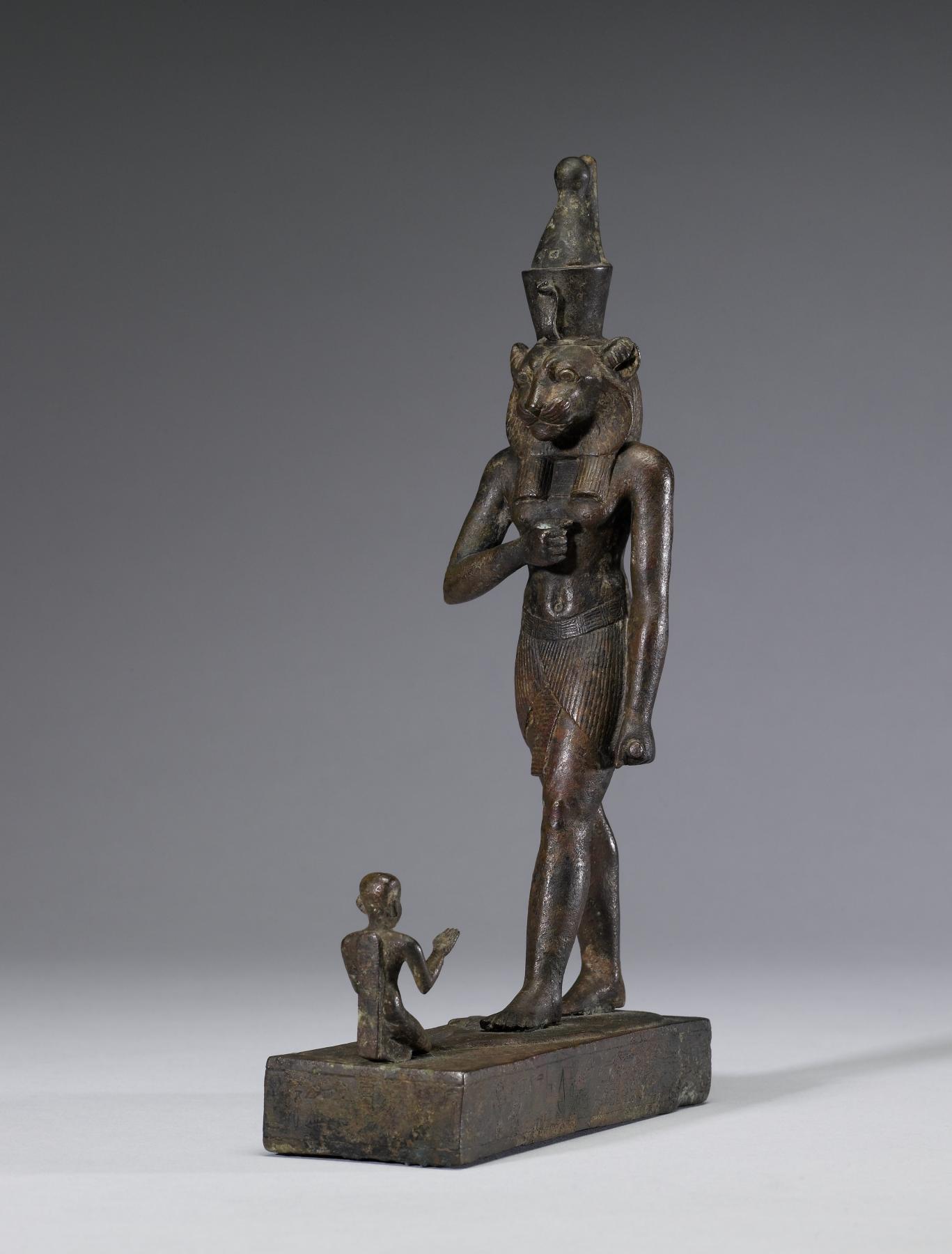
<p>A bronze statuette of the anthropomorphic god Anubis facing a kneeling worshiper. He has the head of a jackal and the body of a human male. The piece has been cast in three sections and then joined. The eyes of Anubis are inlaid with gold and there are traces of gilding on the shoulders, wrists, ankles, neck, wig, and ears. The gilding was delicately applied to the eyes, eyebrows and muzzle, but in other areas it appears to have been applied in a more careless fashion. The piece is well preserved in general but there is a break on the lower back corner of the base and there is some green and bright blue corrosion on the lower side of the base. A hieroglyphic inscription runs around the main base, the base of the Anubis figure and along the back pillar of the worshiper, identifying the dedicant as one Wdja-Hor-resnet, son of Ankh-pa-khered, who is asking for the blessings of the god Anubis. The figure of Anubis is in a striding position with his proper left leg advanced. His proper right arm hangs at his side and the right hand is clenched into a fist with the thumb protruding. The proper left arm is raised and bent at the elbow and there is a drilled hole in the hand for the insertion of an object. Earlier photographs of this piece in Darresy's "Statues de Divinités," show that the missing object was a "was" scepter. He wears a tripartite wig, "shendyt" kilt with deep pleats and a striated belt. A broad collar, armlets and bracelets are incised and gilded. Anklets are suggested by the gilding around the ankles but they are not incised. The musculature of the limbs and the torso is clearly defined. The ears of the god are large and the inner detailing has been carefully modeled. The muzzle comes to a delicate point, accentuating the skillfully modeled eyes, sweeping brows, nose and mouth. There are two cobras at the feet of the deity facing the worshipper. The proper right cobra wears the Red Crown of Lower Egypt and the left cobra wears the White Crown of Upper Egypt. The head of the left cobra is raised slightly higher than that of the right. A worshipper kneels before the god with his back against an inscribed pillar which is pyramidal at the top. He kneels with both knees down on a flat rectangular base, which is attached to the larger main base below. He extends his hands to the god palms down. He wears a "shendyt" kilt, but the pleats are not carved with the same precision that is seen on the kilt of the god. The bent knees are squared off unnaturally and the legs blend together below the kilt. He has an inscribed broad collar. He also wears a skull cap, the front line of which is clearly marked across his brow. The face is round with full cheeks and no definition of the chin. The ears are large and set high. The eyes are natural and do not have cosmetic brows. The nose is straight and the mouth is small with slightly pursed lips. The overall surface of the worshipper is pitted whereas the figure of Anubis has a high polish.</p><p>For the latest information about this object, <cite><a href='https://purl.thewalters.org/art/54.400' rel='external'>Worshipper Kneeling Before the God Anubis</a></cite>, visit the Online Collection of the Walters Art Museum.</p>
Machine-generated from the object's image on Jul 2026. Not curatorial; treat deities, names, and signs below as the model's best reading, not authority.
Bronze gilt with gold-inlay depiction of a kneeling human worshipper before a jackal-headed deity (Anubis) on a rectangular inscribed base.
The image shows a dark bronze figure with a jackal head standing on a rectangular, banded base. Yellow-gold inlay appears on the jackal’s ears and muzzle and on the figure’s belt/garment accents. To the right, a smaller kneeling figure faces the standing jackal-headed deity in a posture consistent with worship. Both the base and the front edge include incised hieroglyphic decoration and short lines of script; the characters are partially worn and cannot be read with certainty from this image resolution. No clearly legible Greek/Coptic/Arabic text is visible. No royal cartouches are clearly identifiable in the visible inscription areas.
Spotted an error, a mis-mapped findspot, or have a suggestion? We read every note.