WALTERS-EG
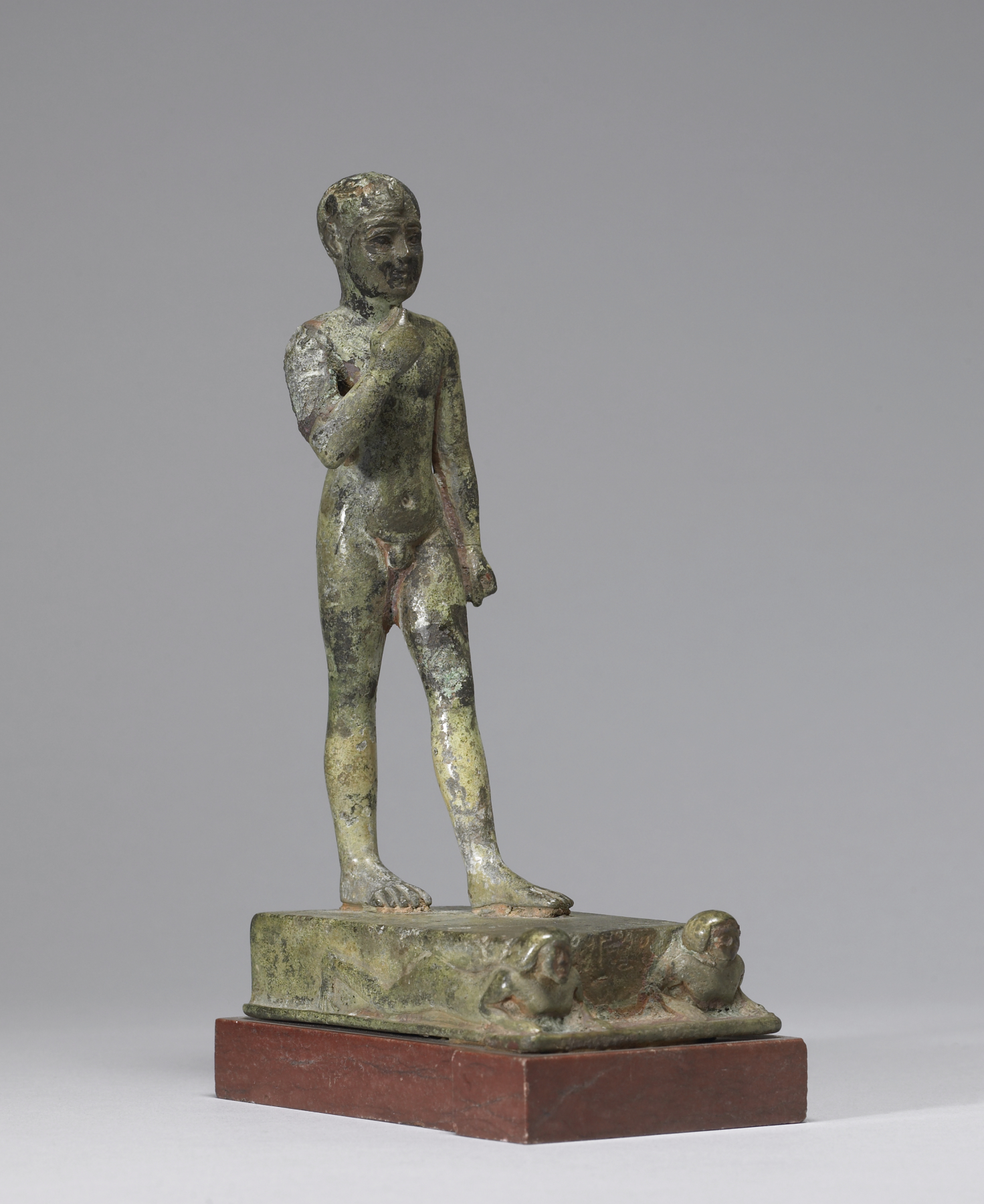
<p>This image may show Khonsu as a child, due to the inscription on the base, although the boy is shown in a manner typically identified as that of Horus the child (Harpokrates). The child wears the double crown of Upper and Lower Egypt, with a sidelock of youth on one side of his head. He holds his right finger to his lips in a typical gesture of childhood, while his left fist is held down at his side.</p><p>For the latest information about this object, <cite><a href='https://purl.thewalters.org/art/54.1973' rel='external'>Harpokrates (Horus the Child)</a></cite>, visit the Online Collection of the Walters Art Museum.</p>
Machine-generated from the object's image on Jul 2026. Not curatorial; treat deities, names, and signs below as the model's best reading, not authority.
Bronze statuette of a nude youthful male deity standing with one hand lifted to the side of his head and the other arm lowered, wearing a tall crown/helmet-like headpiece.
The image shows a small bronze Egyptian figure with a youthful, childlike facial expression and a prominent, vertically rising crown or headdress. The figure stands in a contrapposto-like stance, nude except for a minimal kilt or belt-like element. One hand is raised to the side of the head (thumb/fingers positioned near the crown area), while the other arm hangs downward. The face is modeled with closed or downcast eyes; no clear separate inlaid elements can be confidently distinguished in this monochrome image. The statue base appears as a rectangular block on top of a larger stepped support. No clearly legible hieroglyphs or inscription bands are visible on the visible surfaces of the figure or base. No Greek/Coptic/Arabic text is apparent.
Spotted an error, a mis-mapped findspot, or have a suggestion? We read every note.