WALTERS-EG
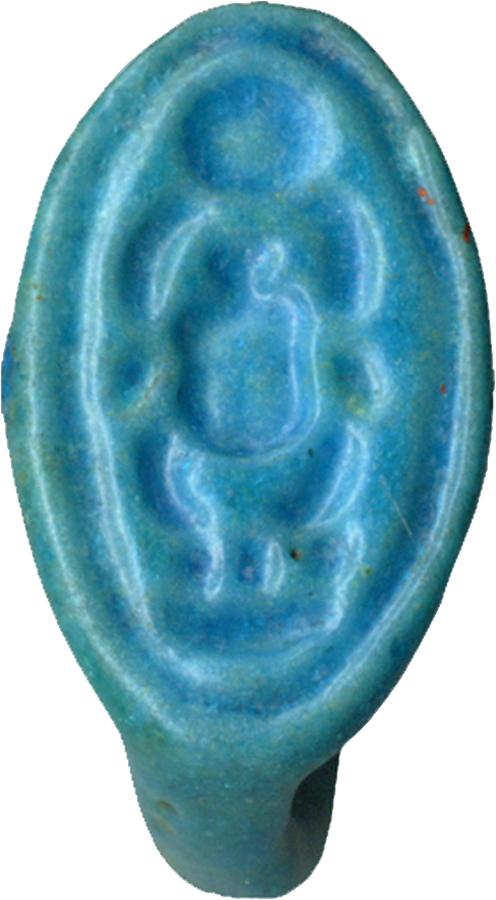
<p>This is a sturdy seal ring of royal blue faience, imitating the shape of precious rings of the period. The inscription gives the throne name of King Amenophis IV (Akhenaten).</p><p>For the latest information about this object, <cite><a href='https://purl.thewalters.org/art/42.201' rel='external'>Seal Ring with the Name of Akhenaten</a></cite>, visit the Online Collection of the Walters Art Museum.</p>
Machine-generated from the object's image on Jul 2026. Not curatorial; treat deities, names, and signs below as the model's best reading, not authority.
An oval blue seal ring/amuletic scarab-like form in Egyptian faience with incised decorative/hieroglyphic-like motifs on the face.
The image shows a single small oval object photographed front-on against a plain background. The surface is glossy blue with lighter blue/white weathering and highlights. Incised lines form a central rounded cartouche-like oval and surrounding motifs resembling hieroglyphic signs or decorative bands. Along the lower portion are horizontal/arched incisions that could represent text or a stylized emblem; however, the individual signs are not clear enough to confidently read the name “Akhenaten.” No other inscriptions or scripts (Greek/Coptic/Arabic) are visible. The object appears intact overall, with minor chips and dark spots on the surface typical of faience wear.
Spotted an error, a mis-mapped findspot, or have a suggestion? We read every note.