no image
WALTERS-EG
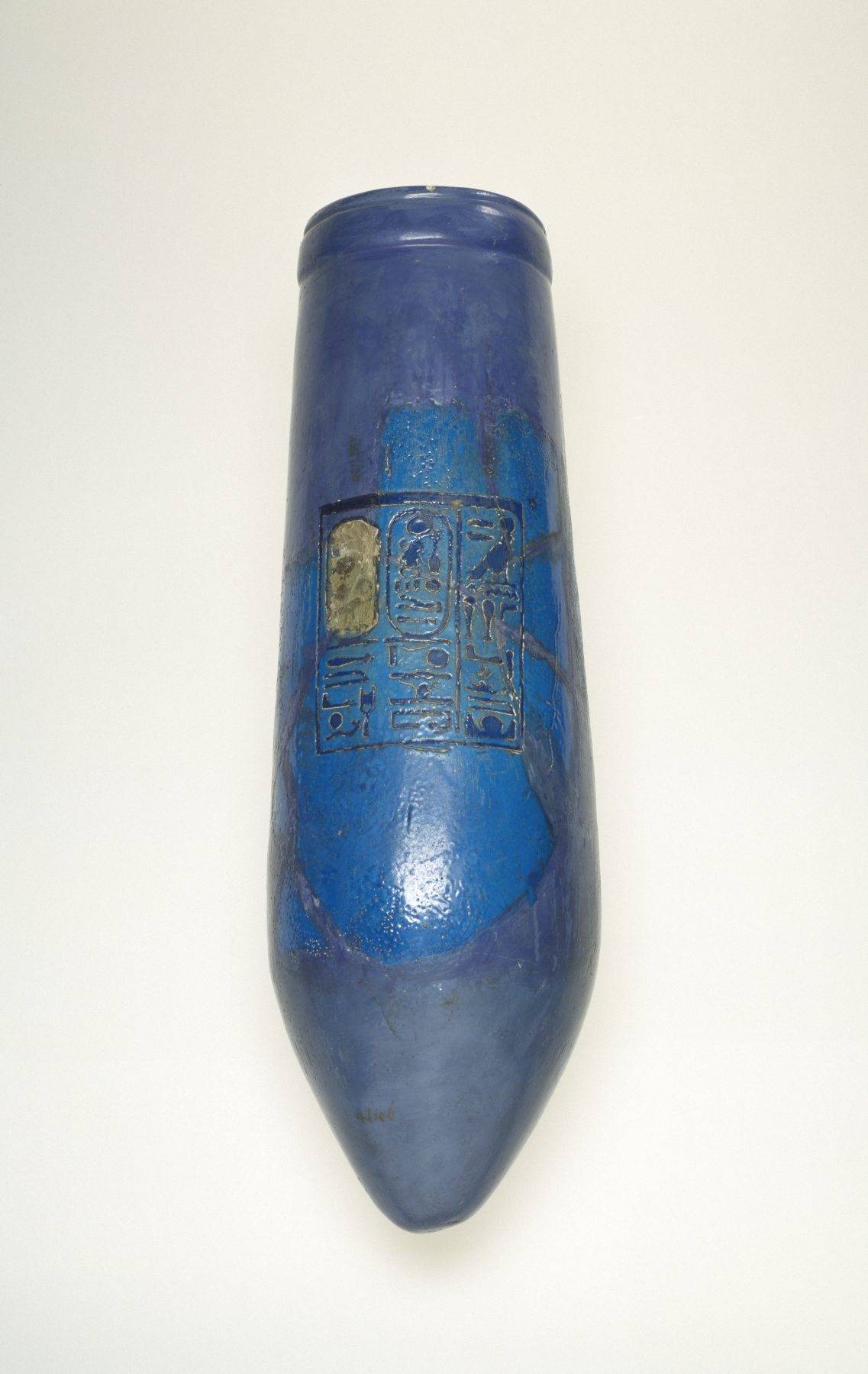
<p>Royalty of the 18th Dynasty commissioned luxury goods in glazed faience and glass. Vessels bearing royal names could have been reserved for royal use or given as gifts to worthy subjects or visitors to the court. This vase contains the names of King Amenophis (Amenhotep) III and Queen Tiye.This small vase was once a part of the MacGregor collection. The vessel's shape imitates a bag or a sack. It was a popular shape during the 18th Dynasty in pottery, stone, painted wood (to imitate stone), as well as faience. The bottom of the vessel is flat allowing it to stand freely on a flat surface. The flat top of the vessel could have originally been closed by a similarly shaped flat lid, as is seen in many examples dating to the 18th Dynasty.The faience most probably incorporates cobalt mixed with copper for the rich, dark-blue color. Before the 18th Dynasty, blue was produced with copper, however, during the 18th Dynasty cobalt mixed with copper was introduced. Cobalt is not attributable to any region or site from the time of Amenophis (Amenhotep) III.The vessel shows a dark residue on the inside. Although chemical analysis has not yet been performed to determine what kind of substance the vessel contained, it is possible that it originally contained some kind of expensive cosmetic, possibly kohl, oil, or perfume.</p><p>For the latest information about this object, <cite><a href='https://purl.thewalters.org/art/48.403' rel='external'>Vase with Names of Amenhotep III and Queen Tiye</a></cite>, visit the Online Collection of the Walters Art Museum.</p>
Machine-generated from the object's image on Jul 2026. Not curatorial; treat deities, names, and signs below as the model's best reading, not authority.
A small dark blue glazed Egyptian faience vase (or amulet-like vessel) with an incised/painted rectangular panel containing hieroglyphs on its front.
The object is shown standing upright on a neutral gray background. It has a rounded, slightly flared shoulder and a narrow neck with a flat or gently domed rim. The body is predominantly dark blue/indigo with lighter greenish-blue edging around a central rectangular register. Within the register, a block of hieroglyph-like signs is visible, though the individual characters are not clear enough to confidently read specific names or royal epithets from the image alone. There are no legible Greek, Coptic, or Arabic inscriptions. No figural deities or royal figures are depicted; identification relies on the presence of hieroglyphic names. The glaze appears intact but with minor surface wear and speckling typical of faience; a few chips/scuffs are visible near the rim and along the surface.
Spotted an error, a mis-mapped findspot, or have a suggestion? We read every note.